

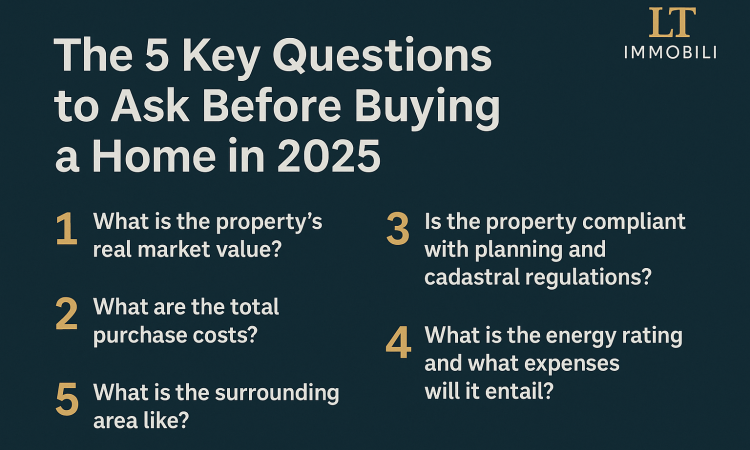
The 5 Key Questions to Ask Before Buying a Home in 2025
Buying a home is one of the most important decisions in a person’s life, both financially and emotionally.
2025 brings new market trends, regulatory updates, and changes in housing needs.
To make a well-informed and safe purchase, it’s essential to ask yourself the right questions before signing any proposal.
Here are the five key questions every buyer should ask.
1. What is the property’s real market value?
The seller’s asking price doesn’t always match the property’s actual market value.
To avoid overpaying, it’s important to:
-
Compare the property with similar ones sold in the same area.
-
Request a professional valuation from a trusted real estate agent.
-
Consider factors such as exposure, maintenance condition, and nearby amenities.
Tip: In 2025, properties located in areas with sustainable mobility services or advanced digital infrastructure tend to maintain their value more steadily.
2. What are the total purchase costs?
Beyond the property price, you should factor in:
-
Taxes and duties (for first or second homes).
-
Notary and registration fees.
-
Any renovation or compliance work.
-
Regular and extraordinary condominium fees.
Tip: Asking for a full breakdown of costs before confirming your offer helps you plan your budget more accurately.
3. Is the property compliant with planning and cadastral regulations?
An often-overlooked yet crucial aspect.
-
Check that the cadastral floor plan matches the actual state of the property.
-
Ensure there are no building violations or irregularities.
-
Verify that systems and certifications are up to code.
Tip: Urban and cadastral compliance is an essential requirement for obtaining a mortgage.
4. What is the energy rating and what expenses will it entail?
In 2025, energy efficiency is a key factor when choosing a home.
-
Check the energy rating stated in the EPC (Energy Performance Certificate).
-
Consider heating, cooling, and maintenance costs.
-
Assess possible energy upgrades, especially in light of available incentives.
Tip: A property in Class A or B not only reduces expenses but is also more likely to appreciate over time.
5. What is the surrounding area like?
A home is not just four walls – the neighborhood matters.
-
Local services, transport links, and green spaces.
-
Safety and overall livability.
-
Future urban development plans that could affect the property’s value.
Tip: Visit the area at different times of the day and week to get a complete picture of its quality of life.
Final Note for the Attentive Buyer
Buying a home in 2025 requires focus and preparation.
Asking these five questions means reducing risks, avoiding unexpected costs, and turning your purchase into a safe and rewarding investment.
An experienced real estate agent is not just a middleman but a strategic ally, providing clear answers, market insight, and protection throughout every stage of the transaction.
