

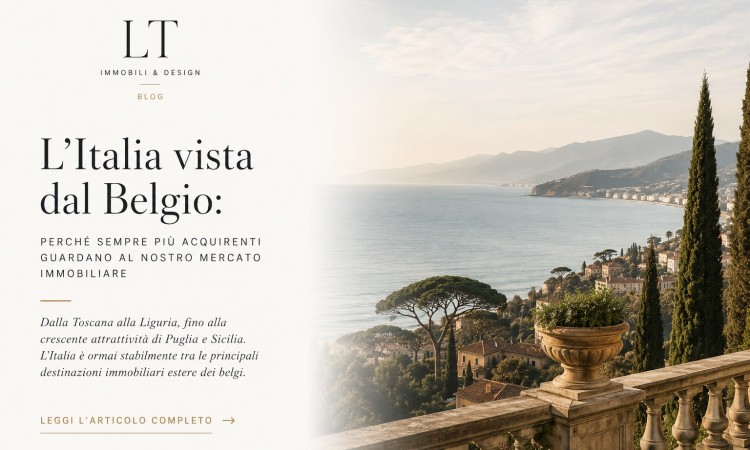
Italy Through Belgian Eyes: Why More Buyers Are Looking at Our Property Market
Italy Through Belgian Eyes: Why More Buyers Are Looking at Our Property Market From Tuscany to Liguria, and the growing appeal of Puglia and Sicily, Italy is now firmly established as one of the leading overseas property destinations for Belgian buyers. Yet behind the figures lies something even more interesting: the way international buyers choose a home in Italy is changing.For many years, whenever the conversation turned to second homes abroad purchased by Belgian citizens, attention almost inevitably focused on France and Spain. Two nearby, familiar markets deeply rooted in Belgian property-buying habits.
Today, however, the picture is more varied. Alongside these two traditional destinations, Italy has firmly established its place.
According to figures from the Belgian Ministry of Finance, reported by the country’s financial press, in 2025 around 247,000 Belgians owned at least one property abroad. This is far from a marginal phenomenon, and Italy ranks among their top three destinations.
The Belgian market is, after all, part of a broader shift in demand that we have already explored in our analysis of foreign buyers in the Versilia property market.
The figure itself is interesting. What it tells us may be even more so.
Choosing a home in Italy often means making a very different decision from buying in Spain or France. It means entering an extraordinarily diverse property market, where travelling just a few hundred kilometres can completely change prices, architecture, landscape and lifestyle.
This diversity is probably one of Italy’s greatest attractions.
You Are Not Simply Buying a House. You Are Choosing an ItalyClimate, food and quality of life certainly play their part. But reducing the phenomenon to these elements would be to read it too superficially.
Italy offers something that is more difficult to quantify: the possibility of choosing between profoundly different property experiences without ever leaving the country.
A villa in the Tuscan hills fulfils very different aspirations from an apartment on the Ligurian coast. A lakeside property does not necessarily compete with a masseria in Puglia. A house in Sicily may appeal to a buyer who would probably never consider Milan or Florence.
Budgets take on different meanings too.
Market data published by Idealista reveals substantial differences in property values between Italian regions. The same budget might therefore buy a relatively modest property in a highly sought-after destination, or considerably more space and land elsewhere.
But price, location and size do not fully explain a property decision. Understanding what buyers are really looking for today often means understanding the kind of experience they hope to find behind a home.
For a Belgian buyer, this means being able to choose not only how much to spend, but above all how to live in their Italian home.
Tuscany Still Has Something That Price Alone Cannot ExplainAmong the destinations attracting international buyers, Tuscany occupies a particular place.
Research into overseas demand compiled by Gate-away.com continues to rank it among the Italian regions attracting the greatest interest from international property seekers.
An important distinction should, however, be made. There is not enough detailed public data to establish precisely what proportion of Belgian buyers choose Tuscany, Liguria, Puglia or Sicily. It would therefore be misleading to create a regional ranking and attribute it specifically to Belgian buyers.
What we can do is observe international demand as a whole and understand why certain areas possess characteristics that are particularly compatible with this kind of buyer.
Tuscany is perhaps the clearest example.
People rarely buy here simply because they have found a bargain.
Indeed, Florence, certain coastal destinations and the region’s best-known areas can command prices considerably above the Italian average.
The value lies elsewhere: in Tuscany’s international recognition, the quality of its landscape, the proximity of art cities, coast and countryside, and the opportunity to buy into something that, in the European imagination, immediately represents a particular way of experiencing Italy.
In this sense, a Tuscan home is not valued solely by its square metres.
It is also valued for what becomes possible once you step outside the front door.
Liguria, the Lakes and the Geography of the Second HomeFor buyers coming from Northern Europe, there is another very practical consideration: how easily a second home can become part of their normal travel habits.
Liguria certainly benefits from being geographically closer to Belgium than many other Italian destinations. But proximity and accessibility are not necessarily the same thing. The geography of the region, seasonal traffic and a motorway network that can be affected by congestion and roadworks can sometimes make journey times less predictable than a map might suggest.
For an international buyer, therefore, the location of a second home is increasingly measured in more than kilometres.
Airports matter. Transport connections matter. Actual travelling times matter. And, above all, so does the possibility of reaching the property conveniently even for relatively short stays.
For an international buyer, therefore, how much the location of a property really matters takes on a broader meaning: not simply distance from the sea or town centre, but accessibility and the ease with which the home can be used throughout the year.
The same consideration applies to the lakes of Northern Italy, which have historically attracted significant international demand, and it is becoming increasingly important when choosing a second home.
Then There Is Another ItalyAt the same time, Puglia and Sicily demonstrate just how much the geography of international interest has changed.
Here, the story is different.
Space, often larger properties, instantly recognisable landscapes and, in many areas, a different relationship between price and size compared with Tuscany or Liguria have opened these markets to buyers who, only a few years ago, might have focused their search elsewhere.
This does not mean that Southern Italy is replacing the traditional destinations.
Rather, it means that international buyers now perceive a much broader Italian property market.
And this may be one of the most interesting changes of recent years.
And What About Versilia?From our own perspective, the question is inevitable.
Where does Versilia fit into this new geography of international property buying?
It is certainly not one of the Italian markets that can compete primarily on price. Nor, perhaps, should it try to.
Its strength lies elsewhere.
The sea and the Apuan Alps within the same landscape; Pisa and its airport within easy reach; Lucca close by and Florence near enough to become a natural part of the experience of owning a second home here. Add to this restaurants, services, culture and an area that continues to live beyond the summer season.
For a Belgian buyer, this combination can carry considerable value.
Liguria is geographically closer to Belgium; Versilia, however, can be remarkably practical thanks to its proximity to Pisa Airport and the relative ease with which it can be reached even for shorter stays.
This becomes particularly important when the property is not imagined simply as a summer holiday home, but as somewhere to spend several periods throughout the year.
Distance from the beach naturally continues to matter. But for someone arriving from Brussels, Antwerp or Ghent, location takes on a broader meaning.
You are not simply buying proximity to the sea. You are buying the ease with which that home can become part of your life.
And this is probably where Versilia has an interesting opportunity with buyers from Northern Europe.
Being European Makes Buying Easier. It Does Not Make the Two Markets the SameFor a Belgian citizen, buying a property in Italy is relatively straightforward in terms of access to the market.
Belgium and Italy are both members of the European Union, so the principle of reciprocity that may apply to citizens of certain non-EU countries does not come into play.
It would be a mistake, however, to confuse this simplicity with the idea that buying a property in Italy works exactly as it does in Belgium.
The purchase offer, preliminary contract, deposit, planning and cadastral checks, the role of the technical professional and the role of the notary all need to be understood within the Italian system.
And this is often precisely where an international property transaction requires greater attention.
The difficulty does not necessarily arise from language.
It arises when two people use apparently equivalent words while attaching different legal consequences or expectations to them.
Sellers Should Be Looking at These Figures TooThere is one final aspect that directly concerns Italian property owners.
If a significant proportion of demand comes from abroad, the marketability of a property cannot be assessed exclusively through the eyes of a local buyer.
A home may have features that the Italian market considers ordinary but which become particularly attractive to someone buying from Belgium.
Good exposure, genuinely usable outdoor space, proximity to an airport, easy access to the sea or a historic town centre, the architectural character of the property and even the ease with which a house can be left unoccupied for several months can carry a different weight for someone purchasing a second home.
This does not mean that every Italian property should be translated into five languages and indiscriminately advertised on international portals.
It means understanding which properties genuinely have international potential.
Above all, it means recognising that not every home can be presented to the same audience using the same tools. Some properties inevitably require a completely different selling strategy, particularly when the potential buyer may need to be found beyond the local market.
Professional photography, video, translation and international promotion are tools. Strategy comes first: identifying the potential buyer, understanding what they are looking for and presenting not only the property itself, but the reason why that particular home might make sense for them.
The LT PerspectiveThe figures tell us that Italy is now one of the principal overseas property destinations for Belgian buyers.
But stopping at the numbers would mean missing the most interesting part of the story.
There is no single Italy that appeals to international buyers.
There is the iconic Italy of Tuscany, the geographically closer Italy of Liguria and the northern lakes, and the emerging appeal of Puglia and Sicily. Then there are areas such as Versilia that can occupy a very specific position within this geography — not necessarily through price, but through a combination of quality of life, sea, services, accessibility and Tuscan identity.
For buyers, this means understanding more clearly what they are looking for.
For sellers, it means understanding more clearly who might be interested in what they own.
And perhaps this is the most important change brought about by the increasing internationalisation of the property market.
A home no longer competes only with the property for sale down the road. It may be competing with a home in Liguria, on one of the Italian lakes, in Puglia — or even in another country.
And when the market becomes international, the way a property is presented must become international too.
