

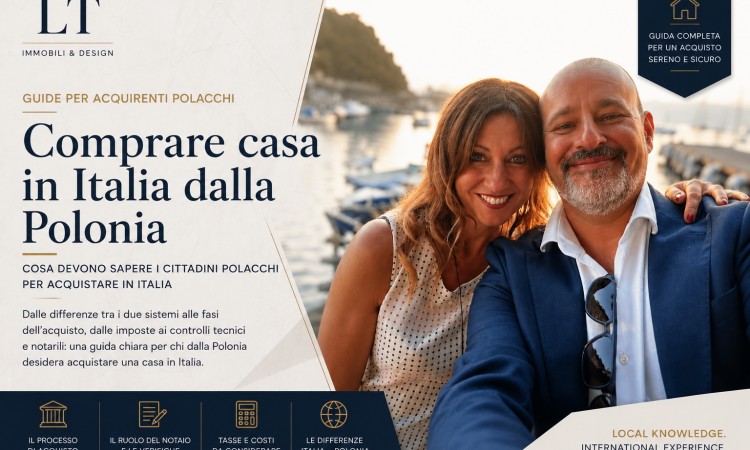
Buying Property in Italy from Poland: What Polish Buyers Need to Know
Buying Property in Italy from Poland: What Polish Buyers Need to KnowBuying a property in Italy may feel relatively familiar to a Polish buyer. Both countries are members of the European Union, both have a notarial system and both provide formal mechanisms for registering property ownership. Yet, once the search turns into an actual purchase, some important differences begin to emerge. Understanding them before making an offer can make the entire process considerably clearer and safer.
Kupujesz nieruchomość we Włoszech?If you are considering buying a home in Italy from Poland, this guide explains the main differences between the Italian and Polish property purchasing systems — and some of the aspects worth understanding before making an offer.
For a growing number of Polish buyers, Italy is no longer simply a holiday destination. Tuscany, Liguria, the Italian lakes and the country’s historic cities are increasingly considered by those looking for a second home, a property where they can spend part of the year, or a long-term investment outside Poland.
Versilia, in Tuscany, fits particularly well within this type of search. The Mediterranean coast, proximity to Pisa and Florence, quality of life and variety of properties — from seaside apartments to villas and historic homes — make it an interesting market for international buyers.
This trend is part of a broader transformation in demand, which we have also explored in our analysis of foreign buyers in the Versilia property market.
However, there is an important principle to understand from the outset: buying a property in Italy does not simply mean applying Polish property-buying habits in another country.
Two European countries, two different property-buying processesAs an EU citizen, a Polish national can generally purchase property in Italy without the restrictions that may apply to buyers from certain non-EU countries.
The main challenge, therefore, is not the right to purchase.
It is understanding how an Italian property transaction is structured.
In Poland, ownership transfers are closely connected to the notarial deed and the księga wieczysta, the land and mortgage register. Italy also places the notary at the centre of the final transaction, with ownership normally transferring through the final deed of sale, commonly known as the rogito notarile.
At first sight, the systems can therefore appear quite similar.
The differences become more apparent in what happens before the final deed is signed.
An Italian property offer is more than an expression of interestOne of the first aspects Polish buyers should understand is the Italian proposta di acquisto, or purchase offer.
When purchasing through an estate agency in Italy, it is common for a buyer to submit a written offer setting out the proposed price, payment arrangements, timing of the transaction and any conditions attached to the purchase.
A deposit or other financial commitment may also accompany the offer.
This document should not automatically be interpreted as the equivalent of an informal expression of interest.
Once properly drafted and accepted by the seller, an Italian purchase offer can have significant contractual consequences.
This is why international buyers should understand every clause before signing, particularly where the offer contains conditions relating to financing, technical due diligence, planning compliance or deadlines.
The “compromesso”: a very Italian expressionAnother important stage is the contratto preliminare di compravendita, commonly referred to in Italy as the compromesso.
Through the preliminary contract, buyer and seller undertake to complete the transaction at a later date.
Ownership does not normally transfer at this stage. That happens with the final notarial deed.
The preliminary agreement must be in writing and is subject to registration. Depending on the circumstances of the transaction, it may also be advisable to have it formally recorded in the Italian property registers through a notary, providing the buyer with an additional level of protection.
For Polish buyers, this stage deserves particular attention because the sequence of offer, preliminary agreement and final deed may not correspond exactly to the process they are accustomed to in Poland.
Not every Italian purchase follows precisely the same route, either.
This is why contractual documentation should ideally reflect the individual transaction rather than being treated as a standard administrative formality.
The notary is central — but does not represent the buyerThe role of the notary will already be familiar to Polish buyers.
In Italy, the notary performs essential checks connected with ownership, mortgages and other legal aspects of the property, as well as handling the formalities required for the transfer.
There is, however, an important distinction to remember.
The Italian notary is an impartial professional.
The notary does not act exclusively in the interests of the buyer or the seller and should therefore not be confused with a lawyer specifically appointed to protect one party’s interests.
For an international buyer — particularly when purchasing a high-value property, a building requiring renovation, an historic home or a property presenting more complex planning issues — independent technical and legal advice can therefore be extremely valuable.
In Italy, the history of the property mattersThis is perhaps one of the most important aspects for international buyers to understand.
Buying an Italian property is not simply a matter of establishing who owns it and whether mortgages or other charges exist.
The property’s planning, building and cadastral history also needs careful consideration.
Italy has an enormous housing stock spanning different historical periods. Properties may have been altered, extended or reorganised several times over decades.
A beautiful home that has been occupied without apparent problems for many years can therefore still require detailed investigation.
Extensions, altered internal layouts, enclosed terraces, outbuildings, changes of use or works carried out by previous owners can all become relevant during a transaction.
These checks should never be regarded as a mere formality: some of the issues that emerge at this stage also help explain why some property deals fall through at the last minute.
This is why we believe it is important to separate the commercial assessment of a property from its technical assessment.
Loving the house is one decision.
Understanding exactly what you are buying is another.
Both matter.
The Catasto does not tell the whole storyThis is another distinction international buyers sometimes underestimate.
The Italian Catasto, or cadastral system, identifies and describes properties primarily for fiscal and administrative purposes. Planning and building compliance, however, depends on the documentation and authorisations relating to the property held by the relevant local authority.
A cadastral floor plan that appears correct should therefore not, by itself, be considered proof of complete planning compliance.
For this reason, when working with international buyers we prefer the period before the purchase not to become simply a negotiation over price.
Before buying a property, it is important to understand its legal and technical history.
This becomes particularly relevant in markets such as Tuscany, where many of the most attractive properties are precisely those with character, history and previous alterations.
Taxes work differently tooThe Italian tax system for property purchases depends on several factors, including whether the seller is a private individual or a company, whether VAT applies, the nature of the property and whether the buyer qualifies for Italy’s prima casa tax relief.
In a standard purchase from a private seller, where prima casa relief does not apply, registration tax is generally 9%, while qualifying purchases benefiting from the relief can be subject to a 2% registration tax.
Transactions subject to VAT follow a different taxation system.
In Poland, property transactions operate within a different fiscal framework. In transactions subject to podatek od czynności cywilnoprawnych (PCC), the tax may generally be calculated at 2% of the property’s market value, subject to the applicable rules and exemptions.
Simply comparing “2% in Poland” with “9% in Italy”, however, would give a misleading picture.
The taxable basis, VAT treatment, available reliefs and circumstances of the individual transaction can materially change the final amount.
For an international buyer, the sensible approach is therefore to calculate the estimated taxation of the specific Italian property before committing to the purchase.
The asking price is not the total cost of buyingThis principle becomes particularly important when comparing properties across different countries.
In addition to the agreed purchase price, an Italian transaction may involve taxes, notarial fees, estate agency fees, technical due diligence and, where appropriate, legal advice and translation costs.
For this reason, when assisting international clients we prefer to discuss the overall acquisition budget, rather than simply the price of the property.
A home offered at €700,000 does not represent a total investment of €700,000.
Understanding the additional costs in advance makes it considerably easier to compare different properties — and to make informed decisions during negotiations.
Language should never become a formalityWhen purchasing a home abroad, having a general idea of what is happening is not enough.
You need to understand exactly what you are signing.
Italian terms such as caparra confirmatoria, acconto prezzo, condizione sospensiva, conformità urbanistica, trascrizione, servitù and provenienza have precise legal meanings.
They do not always correspond perfectly to apparently similar concepts in another legal system.
Translation certainly helps.
But in more complex transactions, something else can be equally important: having a professional who understands the Italian legal concept and can explain its consequences clearly within the cultural and legal context familiar to a Polish client.
Buying in Italy while living in PolandDistance is much less of an obstacle than it once was.
A significant part of the property search can now be prepared before travelling to Italy.
Documentation, floor plans, preliminary checks, videos, virtual tours and detailed information about individual properties allow buyers to make an initial selection remotely.
For someone searching for a second home in Versilia, this can make the visit to Italy considerably more productive: rather than spending days looking at properties that do not meet the requirements, the time can be concentrated on a carefully selected shortlist.
Technology has dramatically reduced geographical distance.
What should not be shortened is the due-diligence process.
For us, this is one of the areas where the quality of assistance provided to an international buyer really becomes apparent. And that assistance should not necessarily end when the final deed is signed: for someone buying from abroad, it is equally important to understand what happens after the final deed, which practical steps follow the purchase and how to organise the management of a new property in Italy.
The LT perspectiveBuying a property in Italy as a Polish citizen is not necessarily more complicated than buying one in Poland.
It is simply different.
Problems often arise when apparently similar procedures are assumed to have exactly the same legal or practical meaning in both countries.
Our approach to international buyers therefore starts with a simple principle: explaining the process before expecting the client to navigate it.
From identifying the right property to negotiating the purchase, from reviewing documentation to coordinating with surveyors, lawyers and the notary, our aim is to create a process in which the buyer understands what is happening, why it is happening and what comes next.
Obsługa klientów z PolskiFor our Polish clients, LT Immobili & Design works in cooperation with an Italian-Polish law firm, with native Polish-speaking legal professionals, who can provide dedicated legal assistance when required and help clients understand the differences between the Italian and Polish systems in their own language.
Because when buying a property abroad, speaking the same language matters.
Understanding the same meaning matters even more.
