

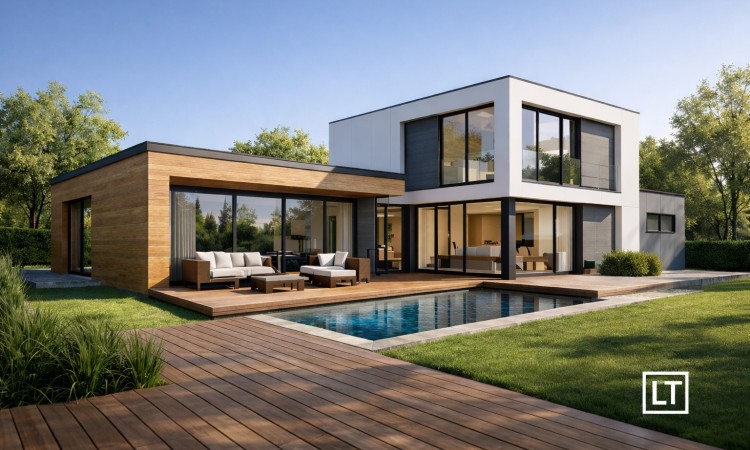
Prefabricated Homes: Advantages, Drawbacks and Demand Trends
What You Should Know Before Choosing
In recent years, interest in prefabricated homes (modular, timber or steel structures, often sold as “turnkey solutions”) has grown steadily in Italy as well. This is not merely a passing trend: buyers are increasingly driven by practical considerations such as shorter construction times, greater cost control, energy efficiency and the possibility of achieving contemporary architectural standards.
From a real estate professional’s perspective, one element stands out clearly: many buyers approach the topic well-informed, yet with very specific uncertainties—particularly regarding permits, land eligibility, cadastral registration and taxation. This is precisely where the difference lies between an appealing idea and a truly viable property investment.
What Is Really Meant by a “Prefabricated Home”
A prefabricated home is a building whose components are manufactured off-site, in a factory, and then assembled on-site. This construction method may involve:
• Timber systems (timber frame, CLT/X-Lam),
• Steel structures (light steel or hybrid systems),
• Precast concrete,
• Volumetric modular units, largely finished before delivery.
The final quality of a prefabricated home does not depend on the method itself, but rather on three decisive factors: design, specifications (materials and systems) and on-site assembly quality.
Demand Trends: Real Growth or Simple Curiosity?
To understand whether prefabricated housing is a genuine structural trend or just a temporary buzz, it is essential to look at multiple indicators.
Market Indicators
Several sector reports suggest consistent growth:
• At a European level, the prefabricated housing market is estimated at approximately USD 34.47 billion in 2025, with projections reaching USD 47.45 billion by 2030, at a compound annual growth rate of about 6.6%.
• In Italy, forecasts for manufactured and modular homes indicate an expected annual growth rate exceeding 5% over the 2025–2030 period.
• Within the timber construction segment, industry observatories highlight ongoing investment in advanced prefabrication and hybrid systems, particularly for residential and public-sector projects.
These figures do not indicate the number of homes sold month by month, but they clearly show a sector that is expanding and becoming increasingly professionalised.
Online Interest Indicators (to Be Read Carefully)
Tools such as Google Trends reveal a growing volume of searches related to prefabricated and modular homes. However, search interest reflects curiosity and research activity, not necessarily actual purchases. For a reliable interpretation, trends should be analysed over a medium-to-long timeframe and compared across different related search terms.
Advantages of Prefabricated Homes
Shorter and More Predictable Construction Timelines
Since a significant part of the work is carried out in controlled factory conditions, construction schedules tend to be more reliable. The main advantage is not simply speed, but predictability.
Higher Quality Control
Industrial production allows for tighter tolerances and systematic quality checks, reducing the variability often associated with traditional on-site construction.
Energy Efficiency
Prefabricated homes are frequently designed with high-performance building envelopes, making it easier to achieve excellent thermal insulation and airtightness, with positive effects on energy consumption.
Reduced Material Waste
Factory-based production optimises material use and minimises waste, offering both environmental and economic benefits.
Future Flexibility
Certain modular systems allow for extensions or modifications over time, which can be appealing for buyers planning phased investments.
Drawbacks and Critical Aspects
Misleading “Price per Square Metre”
Advertised turnkey prices may not include all necessary elements, such as foundations, utility connections, landscaping, professional fees, safety coordination or municipal charges. Transparency is essential when comparing offers.
Planning and Zoning Constraints
A prefabricated home is legally equivalent to any other residential building. The land must therefore be fully buildable, and all planning regulations must be respected.
Transport and Site Accessibility
Logistics can be complex, particularly in hilly areas or historic villages. Access roads, manoeuvring space and load limits must be assessed in advance.
Limits to Customisation
While modern prefabrication allows a high degree of flexibility, extreme customisation may increase costs and complexity, approaching those of traditional construction.
Resale Perception
Although market acceptance is improving, perceptions may still vary depending on location and buyer profile. Clear documentation, proper cadastral registration and energy certification are crucial for future resale.
The LT Immobili Checklist: Key Points to Verify
When assisting clients interested in prefabricated homes, LT Immobili focuses on:
1. Actual land buildability and planning compliance.
2. Required permits and approval timelines.
3. Proper cadastral registration and consistency between design and final build.
4. Detailed specifications and contractual guarantees.
5. Realistic construction schedules.
6. Energy performance and building systems.
7. Tax implications and applicable VAT rules.
Why This Topic Matters Today
The growing interest in prefabricated homes reflects broader changes in housing demand: energy efficiency, cost awareness and faster delivery times. Market data confirms that this is no longer a niche solution, but a maturing segment of the real estate market.
Ultimately, there is no universally “perfect” prefabricated home. The right choice emerges only when land, regulations, design and budget are aligned and carefully assessed.
