

Empty Homes and the Homes We Cannot Find
Empty Homes and the Homes We Cannot FindThe curious paradox of seaside towns. And how life in Versilia has changed since the pandemic.
23 November 2026 | LT Immobili & Design – Versilia Real Estate Observatory
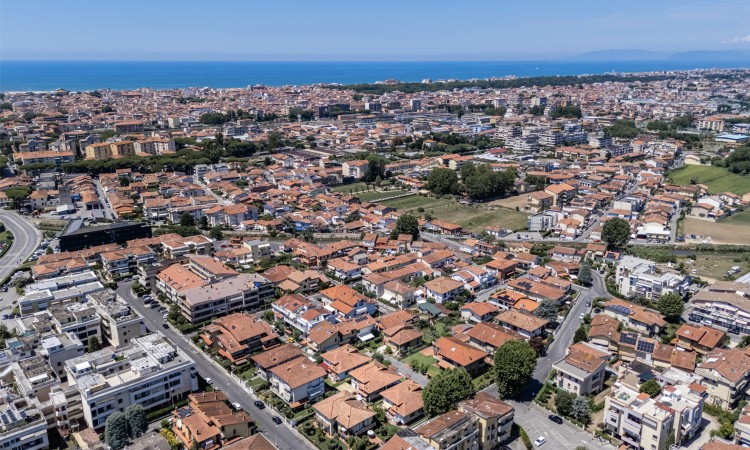
There is something rather curious about Viareggio: in summer, it feels as though there is no room for anyone; in winter, it seems there is room for everyone. And yet finding a home to live in all year round is not always as straightforward as one might imagine.
A walk through certain streets on a November evening reveals just how much the landscape changes with the seasons. Some windows are warmly lit, terraces stand silent, shutters have been closed for weeks, and a few apartments appear to have taken a longer holiday than their owners. Nothing particularly unusual, of course. This is a seaside town, where second homes are almost as much a part of the scenery as the colourful beach cabins, and where, for generations, the property calendar followed a fairly simple rule: people arrived with the first warm days and departed as summer drew to a close.
Then came the pandemic, changing many things, including the way we think about where we live.
When the Holiday Home Stopped Taking HolidaysBefore 2020, living close to one’s workplace was, for many people, a necessity rather than a choice. You could love the sea as much as you liked, but if your office was in Milan, Florence or Bologna, that was where you needed to be on Monday morning. Then came video meetings, makeshift desks in living rooms and that particular kind of colleague who somehow always forgot to mute their microphone. More importantly, however, we discovered that, for certain professions, where you worked and where you lived no longer had to be the same place.
And so a property once used for just a few summer weeks began, in some cases, to accommodate an entire life. The terrace occasionally became an office, the guest bedroom turned into a study, and the little kitchen that had seemed perfectly adequate for preparing a quick pasta after a day at the beach suddenly had to meet the demands of a family living there twelve months a year. Not always with entirely satisfactory results.
This transformation, however, was not limited to people who already owned a second home. Through our work, we have also met families who, following the pandemic, decided to move to Versilia without previously owning a property here, looking for somewhere to buy or rent as their permanent residence. They were not searching for a holiday home, but for a home in which to build their everyday lives. From a real estate perspective, that is a distinction worth making.
Ten Thousand Homes. So Where Is Everybody?At this point, one figure deserves particular attention. According to the Italian National Institute of Statistics (ISTAT) Permanent Population and Housing Census, Viareggio had 38,806 residential properties in 2021, of which 10,627 were not occupied by registered residents. That represents 27.4% of the housing stock: more than one in four homes was not occupied by someone officially resident in the town.
At first glance, such a figure might suggest an enormous supply of available housing. One could almost be forgiven for wondering why anyone struggles to find somewhere to live when so many properties appear to be waiting for occupants. The trouble is that statistics occasionally need a proper introduction. A property not occupied by registered residents is not necessarily an empty home: it might be a second residence used regularly throughout the year, a family property, a home undergoing renovation or simply a property whose owner has no intention of selling or renting it. In other words, closed shutters are not quite the same thing as a “To Let” sign.
And this is where the paradox becomes particularly interesting. A town can have a substantial number of residential properties while offering relatively few homes that are genuinely available to people wishing to settle there. It is a distinction that echoes a subject explored in our article “How Much Is a Home Really Worth? The Problem with Numbers That Seem Certain”: figures are valuable tools, provided we understand what they actually represent.
Meanwhile, some people have decided to stay. In 2024, according to ISTAT data on changes of residence, 3,893 people moved to the seven municipalities of Versilia from other Italian municipalities. Taking into account those who moved away to other parts of Italy, the area recorded a positive net balance of 390 residents. These were not necessarily all families attracted by remote working, and it would be misleading to attribute such movements automatically to the pandemic. In Viareggio, after all, certain indicators of residential mobility were already positive before 2020.
What we can observe through our daily experience of the property market, however, is a change in the motivations of some buyers. Versilia is no longer chosen exclusively as a holiday destination, but also as somewhere to establish a permanent home. And when a holiday destination becomes part of everyday life, the definition of the ideal property changes considerably. In July, being close to the beach may be enough; by November, heating, parking, nearby schools, a reliable internet connection and that extra room which seemed entirely unnecessary in summer suddenly become rather important. The sea remains beautiful, naturally, but it is not particularly helpful when you are trying to find somewhere to put the washing machine.
The Housing Market and the People Behind ItVersilia has always had a special relationship with second homes. It would be unfair to overlook their contribution to the local economy, businesses and the vitality of the area. At the same time, there is a demand for permanent housing driven by very different needs. Someone looking for a property to enjoy for a few months each year can place greater emphasis on personal pleasure, location and lifestyle, while those searching for a primary residence must also consider everyday practicalities and, inevitably, their household finances.
This is not a conflict between fortunate property owners and less fortunate families, but simply the result of different needs meeting within the same market. A home can be beautiful but too expensive; attractively priced but in need of substantial renovation; perfect for a couple on holiday yet far less suitable for a family with two children, a dog and someone working from home. And then there are properties which, although they physically exist, never enter the market at all. This is why counting houses is not enough to understand how many homes are genuinely available.
When discussing housing difficulties, the temptation is to look for a simple answer. Not enough homes? Build more. Too many empty properties? Put them all on the market. Unfortunately, a town is not a warehouse where a few boxes can simply be moved from one shelf to another. Properties have owners, histories, different building conditions and market values, while people have needs that cannot be met merely by finding four walls and a roof.
Perhaps we should begin by distinguishing between the amount of existing housing stock and its ability to meet the needs of those looking for somewhere to live. A property that exists is not necessarily a property that is available, and an available property is not necessarily one that people can afford.
This reflection also comes from our everyday work at LT Immobili & Design. We meet people who see the same area through very different eyes: some are searching for a second home where they can return to childhood memories every summer; others want to relocate permanently, begin a new chapter in retirement or, having discovered Versilia from abroad, realise that spending a few weeks here is wonderful, but staying longer might be even better. Behind seemingly similar property enquiries, there are often entirely different plans for the future.
Meanwhile, Versilia continues to evolve, welcoming visitors, preserving its character as a holiday destination and becoming home to people who choose to settle here permanently. The pandemic may have accelerated some of these decisions, but it would be simplistic to attribute every change to Covid. Towns also evolve through slower processes, shaped by changing needs, habits and priorities. Perhaps the most interesting development is not that some second homes have become permanent residences, but that, for certain families, Versilia has ceased to be merely somewhere to go on holiday and has become somewhere to come home to.
A difference measured not only in square metres, property prices or statistics, but also in the windows that remain illuminated long after summer has ended.
