

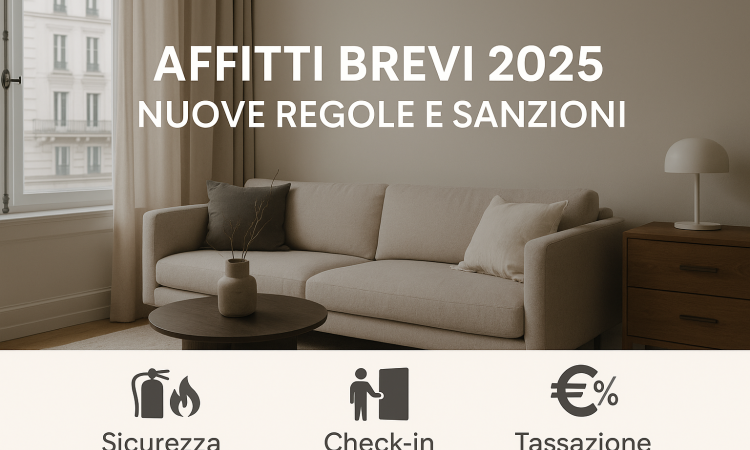
Short-Term Rentals and Tourist Lettings: The New 2025 National Rules You Need to Know
Introduction
Short-term rentals in Italy are increasingly popular, both for those with a second home and for those looking to turn a property into an income-generating investment.
However, starting from January 1st, 2025, a new national regulatory framework comes into force, introducing unprecedented obligations, restrictions, and penalties.
Here’s everything owners and managers need to know to avoid costly mistakes and operate within the law.
1. Mandatory National Identification Code (CIN)
From 2025, every property used for short-term rentals must have a CIN – National Identification Code, which must:
-
Be obtained from the government portal;
-
Be clearly displayed outside the property;
-
Be included in all online and offline advertisements.
Penalties: from €800 to €8,000 for failure to display the CIN or include it in listings.
2. Mandatory Safety Measures
Every rental property must be equipped with:
-
Gas and carbon monoxide detectors;
-
Portable fire extinguishers;
-
Clear and unobstructed emergency exits (where applicable).
Penalties: from €600 to €6,000 for non-compliance.
3. Check‑in Must Be In Person
From 2025, self-check‑in (lockboxes or smart locks without a personal meeting) will no longer be allowed.
Owners must meet guests in person to:
-
Verify their identity;
-
Register them with the police via the “Alloggiati Web” portal.
Penalties: up to €3,000 for violations.
4. Taxation: Higher Flat Tax Rate from the Second Property
For 2025:
-
21% flat tax for the first property;
-
26% for the second to fourth property;
-
More than 4 properties → mandatory business registration with VAT number.
5. SCIA and Business Requirements
Those managing more than 4 properties must:
-
File a SCIA (Certified Notice of Business Start) with the local municipality;
-
Operate as a licensed hospitality business;
-
Comply with hospitality-specific tax and safety laws.
Penalties: up to €10,000 for unlicensed business activity.
6. Tax Controls and Data Sharing
From 2025, the European DAC7 Directive requires platforms like Airbnb and Booking to:
-
Report all host income to the Italian Revenue Agency;
-
Share property and host identification data.
Result: renting without declaring income will be virtually impossible.
7. Municipal Powers
Local municipalities can introduce further restrictions, such as:
-
Annual rental day limits;
-
Restrictions in high-tourism zones;
-
Caps on the number of rental licenses.
Why It Pays to Comply Now
Complying with the law not only avoids hefty fines, but also:
-
Ensures guest safety and professionalism;
-
Improves ratings and visibility on OTAs;
-
Increases long-term profitability of your investment.
