

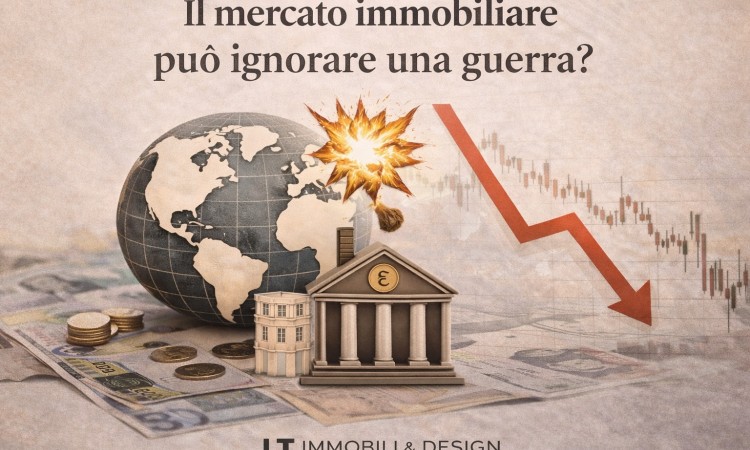
Can the real estate market ignore a war?
Can the real estate market ignore a war?
Geopolitics, mortgages and buyer confidence: what really happens when the economy enters a period of tension
When geopolitical tensions rise around the world, the first reaction is almost always the same: attention immediately turns to financial markets, stock exchanges and raw materials. Much less frequently do people reflect on another fundamental sector of the economy: the real estate market.
Yet property, although often perceived as a stable and “safe-haven” investment, does not exist in isolation from the global economic context. Wars, energy crises, inflation and international tensions can have indirect but very real effects on real estate transactions.
The question many people ask is therefore legitimate: can the real estate market really ignore a war?
As often happens in economics, the answer is more nuanced than it might initially appear.
Is real estate really a safe-haven asset?
Historically, property has been considered one of the most solid investments during periods of economic uncertainty. A home represents a tangible asset, rooted in a specific territory and less exposed to the sudden fluctuations typical of financial markets.
For this reason, during times of international instability, some investors tend to move part of their capital into real estate. In certain areas, this phenomenon can even lead to an increase in demand.
However, the property market is not immune to broader macroeconomic dynamics. Geopolitical tensions often generate chain reactions that can indirectly influence the real estate sector.
Inflation and the cost of borrowing
One of the most immediate consequences of international crises is rising economic uncertainty. When this happens, central banks often adopt tighter monetary policies in order to contain inflation.
Higher interest rates have direct consequences for the real estate market.
More expensive mortgages generally mean:
• higher monthly payments
• reduced access to credit
• greater caution from households considering a purchase
This does not necessarily mean the market will stop entirely, but it can slow down the number of transactions and lengthen selling times.
The role of confidence
Beyond financial aspects, there is another element that is often underestimated but extremely important: confidence.
Buying a home is one of the most significant financial decisions a family can make. When the international context appears unstable, many people tend to postpone major commitments.
This does not mean that property loses its value, but rather that uncertainty about the economic future increases.
The result is a more cautious market, where buyers analyze every decision more carefully.
Local markets react differently
It is also important to remember that the real estate market is not a uniform system. Global dynamics always intersect with local factors: housing demand, the attractiveness of the area, property quality and the presence of international buyers.
In some tourist destinations or areas with a particularly high quality of life, interest in property can remain strong even during periods of economic tension.
The Italian real estate market, and particularly that of certain highly sought-after areas, often shows greater resilience than many other sectors.
The perspective of LT Immobili & Design
In our daily work we closely observe how the real estate market reacts to changes in the economic environment.
International crises rarely stop the market entirely, but they can change its rhythm. Buyers become more selective, banks more cautious and negotiations more thoughtful.
In these moments, the importance of a correct property valuation and a realistic sales strategy becomes even more evident.
The real estate market does not exist outside history. Yet precisely because of its tangible and territorial nature, property often continues to represent one of the most solid long-term investments, even during periods of uncertainty.
