

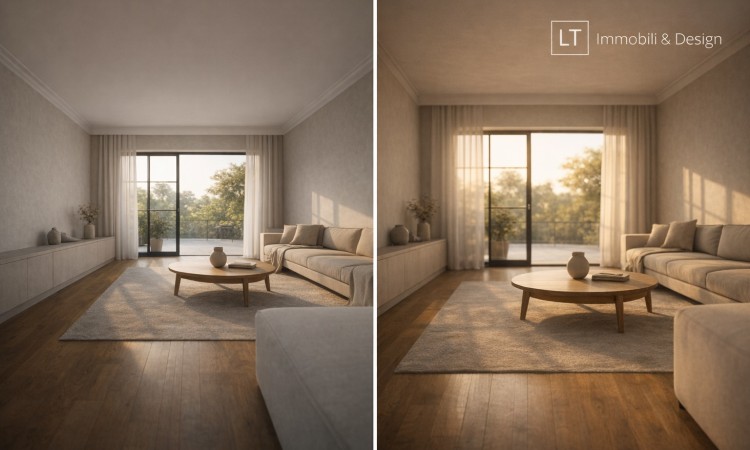
House Seen Online, House Experienced in Person: Why It Often Disappoints
House Seen Online, House Experienced in Person: Why It Often Disappoints
When Digital Expectations Exceed Reality (and What Really Happens During a Viewing)
A property can look perfect online and still disappoint in person.
Here’s why it happens, which communication mistakes cause it, and how aligning expectations with reality leads to better sales results.
House Seen Online, House Experienced in Person: Why It Often Disappoints
When Digital Expectations Exceed Reality (and What Really Happens During a Viewing)
The First Viewing Happens Online (and That’s Not a Detail)
In today’s real estate market, the “zero-th viewing” does not take place in person.
It happens on a phone — often in just a few seconds.
Buyers scroll through listings, compare images, select, discard. In this initial phase, a silent yet powerful mechanism takes shape: the mental image of the property.
Photos, descriptions, the order of the rooms, the tone of the text, virtual tours, videos — everything contributes to building an expectation. And that expectation becomes the benchmark long before the actual visit.
When buyers finally step inside the property, the experience does not start from zero.
It starts with a comparison to what they believed they would find.
Why a “Perfect Online” House Can Disappoint in Person
Disappointment rarely stems from a single visible flaw.
It stems from a feeling: “This is not what I expected.”
And that feeling can arise from very common factors:
-
Proportions altered by wide-angle lenses or strategic framing
-
Lighting and colors different from reality (heavy retouching, strong HDR, ideal shooting conditions)
-
Context only partially perceived (noise, views, proximity to services, traffic)
-
Atmosphere not prepared (smell, temperature, humidity, visual clutter)
-
“Empty” spaces without scale (without furniture, it’s harder to perceive dimensions and function)
-
Critical elements not properly addressed (dated bathroom, window frames, maintenance issues, technical details)
The point is not whether to enhance or not enhance.
The point is avoiding unintentionally promising something that the in-person visit cannot confirm.
Communication vs. Reality: Where the Gap Is Created
Many listings fall into one of two extremes:
1) They Show Everything, but Tell Very Little
There may be many beautiful photos, yet without a logical sequence.
The buyer does not truly understand what it feels like to live in the property — how you enter, how spaces flow, where daily life happens, how rooms connect.
Result: the viewing becomes a “test” to figure out what was unclear online.
2) They Tell a Lot, but Show Selectively
The description is rich and emotional, but the images do not fully support the narrative or avoid what truly matters.
The buyer arrives prepared — but based on an idealized perception.
Result: the viewing becomes a cross-check, and trust drops at the first inconsistency.
In both cases, the buyer enters verification mode.
And when someone is verifying, they are no longer imagining their future life in that home — they are looking for inconsistencies.
The Real Damage of Disappointment: It’s Not “I Don’t Like It,” It’s “I Don’t Trust It”
Disappointment does not only generate an aesthetic judgment.
It changes the buyer’s attitude.
When the first impression is contradicted:
-
the buyer becomes more rigid in negotiation
-
comparisons with other properties become stricter
-
minor flaws seem larger than they actually are
-
the viewing loses its natural role (confirmation) and becomes an obstacle
Even a well-priced property with solid features can “lose strength” simply because the experience failed to match the original promise.
And in the market, once a property loses strength, it rarely regains it easily.
An Effective Viewing Should Never Surprise Negatively
A well-prepared viewing does not need to create a “wow” effect at all costs.
It needs to create coherence.
The buyer should think:
“This is exactly how I imagined it. In fact, now it makes even more sense.”
That is the point.
The viewing should confirm, not contradict.
When the in-person experience confirms what the buyer perceived online, the mind stops verifying and begins deciding.
What It Means to Professionally Align Expectations and Reality
Alignment does not mean making everything perfect.
It means making everything readable.
It requires working on three levels:
1) Visual Clarity
Organized photos, logical sequencing, complete rooms, coherent details. Not “more photos,” but “the right photos.”
2) Realistic Narrative
A description that anticipates what the visit will confirm: highlighting strengths while also presenting objective characteristics that help buyers interpret the property correctly.
3) Experience Preparation
A viewing is sensory: light, air, temperature, smells, sounds, spatial perception.
If you do not prepare the experience, you can lose even when the house itself is good.
The Perspective of LT Immobili & Design
For LT Immobili & Design, real estate communication is not a “showcase.”
It is an intelligent filter.
Its purpose is to select better-qualified viewings, reduce distorted expectations, and create the conditions for a natural in-person encounter.
Presenting a property correctly means bringing the buyer into the right mindset — not to be convinced, but to recognize.
When narrative and reality coincide, the viewing becomes what it should be:
a decisive step.
And in an increasingly selective market, this coherence is not a detail.
It is a sales strategy.
If you are selling your home and want to avoid inconclusive viewings, the first step is not “more advertising.”
It is presenting the property coherently, so that online and in-person speak the same language.
