

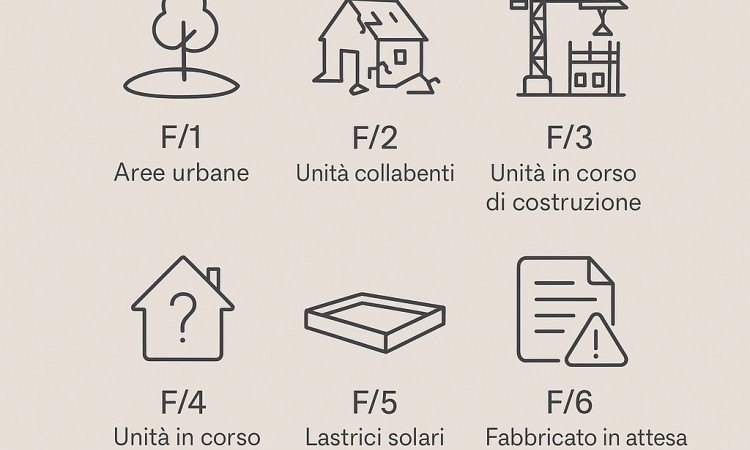
Cadastral Categories Group F
Cadastral Categories Group F: Properties in Transition or Undefined
Group F includes all real estate units that do not yet have a definitive use or that, due to their nature, cannot be classified under categories A to E. These are evolving properties, awaiting completion, declaration, or having special features. Generally, they do not generate cadastral income, but proper registration is essential for tax and urban planning purposes.
Subcategories of Group F
F/1 – Urban Areas
Open areas within urban settings, intended for public or private use, but without buildings. May include yards, courtyards, gardens, or maneuvering spaces. Often considered appurtenances of registered buildings.
F/2 – Collapsing Units
Buildings no longer usable or habitable, in an advanced state of disrepair. Missing systems or roofs, sometimes reduced to ruins. Exempt from IMU, but require technical certification. Often included in recovery projects.
F/3 – Units Under Construction
Properties where construction has started but is not yet complete. Used to register buildings still in progress. They don’t generate income but are necessary for future tax deductions (e.g., renovation bonuses).
F/4 – Units Being Defined
Structures completed externally but not yet functionally identified (e.g., no internal divisions, installations, or defined use). A provisional category pending final cadastral classification.
F/5 – Flat Roofs
Flat surfaces atop buildings, not constructed upon. Can be converted into terraces, rooftop gardens, or photovoltaic installations. If independently identified, they are registered as F/5.
F/6 – Building Awaiting Declaration
Used by the Revenue Agency for buildings not yet declared by the owner but visible in cadastral maps. These represent irregularities to be resolved.
F/7 – Public Communication Network Infrastructure
Includes towers, antennas, cabinets, repeaters, and telecommunication masts. Ensure network coverage. Registered separately; they do not generate direct income but may hold asset value.
Technical and Tax Aspects
-
Group F units do not pay IMU but may become taxable after completion or transformation
-
F/3 and F/4 are required to access building incentives (Superbonus, Ecobonus, etc.)
-
F/6 signals an irregularity: failure to address it may lead to penalties
-
Though income-free, some units can be inherited, sold, or subject to inspections
Practical Examples
-
A roofless rural house to be renovated may be classified as F/2
-
A building under construction is F/3 until works are completed and registered
-
A privately owned flat roof can be categorized as F/5
-
A 5G antenna installed on a public building may fall under F/7
In Summary
Group F represents properties in transformation or with undefined status. Knowing this category is crucial to navigating urban regulations, tax benefits, and legal obligations.
