

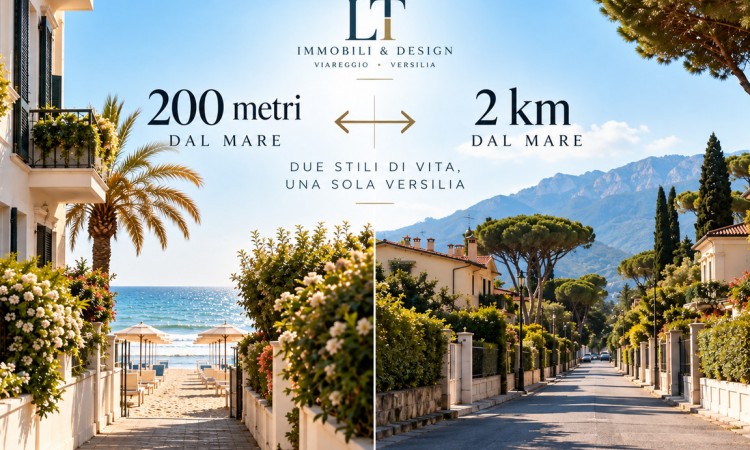
Buying a Home 200 Metres or 2 km from the Sea: How Much Difference Does It Really Make?
Buying a Home 200 Metres or 2 km from the Sea: How Much Difference Does It Really Make?From Viareggio to Forte dei Marmi, the distance from the beach can influence a property’s value, everyday habits and even the way we experience a home. But does living closer to the sea necessarily mean making a better purchase?
Some distances seem insignificant on a map but can make an enormous difference in everyday life.
Two kilometres, for example. By car, it is only a few minutes, traffic permitting. By bicycle, it is generally a short ride. On foot, however, it can mean a half-hour walk, particularly when the August sun is showing no mercy.
Yet in Versilia’s property market, those two thousand metres can separate two completely different ways of living.
People looking to buy a home in Viareggio, Lido di Camaiore, Marina di Pietrasanta or Forte dei Marmi often begin with a seemingly simple request: “We’d like somewhere close to the sea.”
But what does close actually mean? Two hundred metres? Five hundred? A kilometre?
The answer is not simply geographical. It involves time, habits, budget and the way we imagine living in that property.
Because choosing a home 200 metres from the beach rather than 2 kilometres from the coast often means choosing between very different priorities.
Is It Better to Buy a Home 200 Metres or 2 km from the Sea?There is no single answer that works for everyone. A home 200 metres from the sea generally makes it easier to reach the beach on foot and enjoy the coast spontaneously. At a distance of 2 kilometres, the same budget may offer opportunities to purchase properties with more living space, outdoor areas or different features.
However, the comparison depends on the location, neighbourhood, property type and the buyer’s individual needs.
In Versilia, distance from the sea is not the only factor determining a property’s value. The surrounding environment, parking availability, condition of the building and suitability for year-round living are equally important considerations.
The more useful question, therefore, is not simply which property is closer to the beach, but which location best suits the way you want to live.
The Luxury of Leaving Home Without Making PlansImagine a July morning.
Breakfast is over, the sun is already high and someone suggests going for a swim.
If your home is just two hundred metres from the beach, very little preparation is needed. You pick up a towel, walk out of the door and find yourself by the sea a few minutes later.
There is no need to search for parking, prepare the car or decide in advance how long you intend to stay.
You can go to the beach for just half an hour, return home for lunch and head out again in the afternoon.
This freedom has a value that rarely appears on a floor plan or in a property description.
It is not about square metres. It is about time.
Living close to the sea does more than shorten the journey to the beach: it allows you to enjoy the coast more spontaneously.
And that spontaneity is precisely what many buyers are looking for.
But there is another side to the story.
In particularly popular areas, living just a short walk from the coast can also mean dealing with seasonal crowds, heavier traffic and parking difficulties.
That is not always the case, of course. Nevertheless, it is worth considering, especially if the property will also be used outside the summer season.
After all, a home that seems perfect during a quiet Sunday walk in spring may tell a rather different story on a busy Saturday in August.
Two Kilometres Can Offer What Two Hundred Metres Cannot GuaranteeNow imagine a different situation.
The property is approximately two kilometres from the coast. Getting to the beach requires a little more planning, although the journey by bicycle may still be relatively short.
In return, the home might offer larger rooms, a garden, greater peace and quiet or a different balance between price and living space.
This is not a universal rule. Much depends on the area, the type of property and the characteristics of the local market.
But it is a compromise many buyers find themselves considering.
Is it better to own an apartment close to the beach or a more spacious home, perhaps with a private garden, just a few minutes further inland?
For a couple spending only occasional summer weekends in Versilia, being able to walk to the beach might be essential.
For a family spending several months of the year there, an additional bedroom, a garden or private parking could be far more valuable.
This reflects a broader change in what today’s property buyers are really looking for: the quality of a home depends not only on its location but also on how well its spaces and surroundings meet everyday needs.
Distance from the sea is an objective measurement. The importance we attach to it, however, is deeply personal.
In Viareggio, Forte dei Marmi and the Rest of Versilia, Two Kilometres Do Not Always Mean the Same ThingAnyone familiar with the area knows that distance from the coast can mean different things, even within the same town.
In Viareggio, for example, living close to the famous seafront promenade means having more than the beach within walking distance. Shops, restaurants and numerous everyday services are also nearby.
Further inland, the urban environment gradually changes, along with the types of properties available and, in some neighbourhoods, the opportunities to find outdoor spaces or different housing solutions.
In Lido di Camaiore, choosing between the areas closest to the seafront and those further inland may involve considerations such as residential tranquillity, parking availability and the characteristics of individual properties.
In Marina di Pietrasanta, pinewoods, tree-lined avenues and neighbourhoods with distinct identities make the actual route to the beach particularly important.
In Forte dei Marmi, distance from the sea takes on yet another meaning.
The town is also renowned for its prestigious property market, with detached villas, homes surrounded by generous gardens and demand from both Italian and international buyers.
Here, proximity to the beach can be highly desirable, but it is not necessarily the deciding factor.
Privacy, garden size, distance from the town centre and the quality of the residential surroundings can all play a significant role in the decision.
A villa further from the seafront may be more attractive than a property closer to the coast if it better reflects the buyer’s lifestyle and expectations.
Not all streets are alike, and not all distances feel the same. A kilometre along a pleasant, shaded route may seem much shorter than a smaller distance along a busy road.
In our daily work at LT Immobili & Design, across Viareggio and Versilia, we often observe that distance from the sea is merely the starting point of a property search. During viewings, buyers begin to consider aspects they may initially have overlooked: the tranquillity of the neighbourhood, outdoor space, parking and whether the home can be enjoyed throughout the year.
That is when a search based on metres begins to become a decision based on quality of life.
The Distance Advertised Does Not Tell the Whole StoryThere is one detail that many buyers discover only after viewing a property.
The distance from the sea stated in a property listing does not necessarily correspond to the route you will actually take to reach the beach.
Five hundred metres as the crow flies may involve a longer journey because of the road layout, pedestrian crossings and available access points.
Likewise, two homes apparently located at the same distance from the coast may require different amounts of time to reach a beach club or a public beach.
For families with young children, people using pushchairs or those accompanying someone with reduced mobility, these differences can be particularly important.
The same applies to buyers who expect to travel mainly by bicycle.
A convenient, safe cycle route can make a greater distance feel effortless. Conversely, an awkward or unpleasant road can make a beach that looks close on the map seem surprisingly far away.
For this reason, when assessing a coastal property, it is more useful to understand the actual route to the beach than to rely solely on the distance quoted in the advertisement.
Sometimes walking or cycling that route once, preferably at the time of day you expect to use it, can reveal more than any photograph.
How Much Does Distance from the Sea Affect Property Prices?Proximity to the coast can have a significant influence on property values, particularly in popular seaside destinations.
However, it would be misleading to suggest that every additional hundred metres from the beach produces a specific percentage reduction in price.
Versilia’s property market is far too varied to be explained by such a simple formula.
A home close to the sea may command a higher price than a comparable property further inland, but any meaningful comparison must account for several factors: floor area, condition, floor level, lift access, outdoor space, parking, building quality and the characteristics of the neighbourhood.
The type of property also matters.
Comparing a third-floor apartment without a lift, just a short walk from the beach, with a small detached house and garden two kilometres from the sea means comparing two fundamentally different properties.
The real question, therefore, should not simply be how much more a home near the coast costs.
It should also be what we are prepared to give up in order to buy it.
With the same budget, the choice might be between a smaller apartment close to the beach and a larger home in a less central location.
Or between a renovated property and one requiring substantial work.
We are not simply comparing two prices.
We are assigning a financial value to our priorities.
A Holiday Home Is Not Chosen in the Same Way as a Main ResidenceThere is another distinction that often changes the entire decision-making process.
A property purchased for holidays is not necessarily assessed according to the same criteria as a permanent home.
Someone using a property only during the summer may place particular importance on proximity to the beach, ease of maintenance and the ability to get around without a car.
Someone living permanently in Versilia may give greater weight to parking, nearby schools, transport connections and the practicality of the property throughout the year.
Naturally, these needs can overlap.
A holiday home can be spacious, while a main residence can be located just a short walk from the sea.
But the way we intend to use a property strongly influences which characteristics we consider most important.
This is particularly relevant for international buyers purchasing in Versilia without yet knowing the area well.
After all, visiting a destination on holiday is not quite the same as understanding what everyday life there is really like.
The Perfect Home for Everyone Does Not Exist. Not Even 200 Metres from the BeachThere is something rather curious about property searches.
Certain features appear to have almost universal appeal.
A sea view, for example. Or being within walking distance of the beach.
Yet when admiration turns into the practical decision to buy, priorities can change.
An apartment two hundred metres from the sea may impress many people while proving unsuitable for the person who would actually live there.
A home further inland, perhaps less appealing on paper, may turn out to be exactly what a particular buyer needs.
We explored this distinction in another article, Why the Home Everyone Loves Is Often Not the First to Sell.
Because the property market does not necessarily reward the home that receives the most compliments.
When supply and demand meet, it is the property that satisfies the needs of someone genuinely ready to buy that finds its buyer.
And distance from the sea is only one part of that equation.
The Sea Will Always Be There. But Our Lives ChangeThere is one final consideration that rarely appears in property search criteria: the way our lives evolve over time.
A young couple may consider an apartment just a short walk from the beach absolutely perfect.
A few years later, with children, they may begin looking for an extra bedroom, outdoor space or a more practical layout.
A family that currently considers a large garden essential may eventually prefer a home that is easier to maintain and closer to everyday services.
Even our relationship with the sea can change.
What was once somewhere we visited every day may become the setting for evening walks, or simply a reassuring presence that we no longer feel the need to reach quite so often.
Choosing a home therefore also means trying to imagine how our habits might change.
We cannot always predict the future.
But it is worth thinking about.
The Right Question Is Not How Far Away the Sea IsWhen searching for a property, distance from the beach is a useful filter. It helps narrow down the options and identify areas that match our preferences.
But when the time comes to make a decision, that number alone is no longer enough.
We need to imagine an ordinary day.
Not just a perfect Sunday in August.
A rainy November morning when we need to go shopping. A spring afternoon when cycling to the beach would be a pleasure. A summer evening when going for a walk should not require any particular planning.
It is in these everyday moments that a seemingly insignificant distance can become an extraordinary advantage—or a perfectly acceptable compromise.
Because the value of living close to the sea depends not simply on the number of metres separating us from the beach, but on how much that proximity genuinely improves our lives.
And perhaps that is the question worth asking before buying a home in Versilia.
Not simply:
“How far is it from the sea?”
But rather:
“How much do I want the sea to be part of my everyday life?”
