

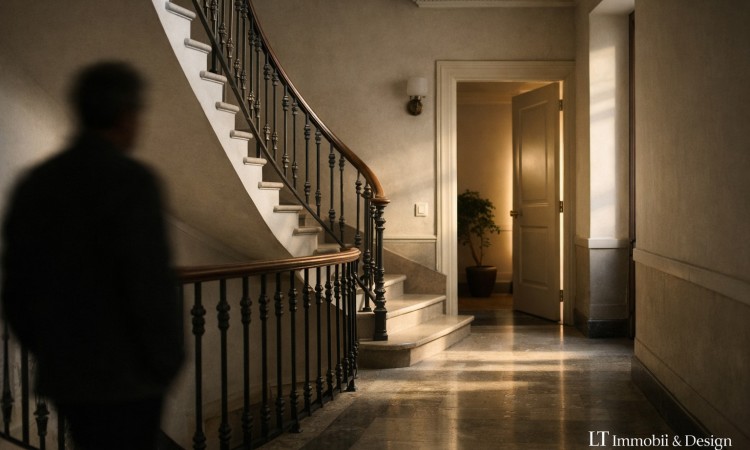
The Hidden Role of Neighbours in Selling a Home
The Hidden Role of Neighbours in Selling a Home
What’s not in the listing… but influences the sale
When preparing a property for the market, attention is usually focused on clear and measurable elements:
size, location, condition, price.
Everything that can be photographed, described and enhanced.
Yet there is a factor that rarely appears in listings — but plays a decisive role in how buyers perceive a property:
the human context in real estate sales.
Neighbours.
The building.
The life happening around the home.
It is not a detail.
It is experience.
A home is never viewed in isolation
During a viewing, buyers do not only observe spaces.
They listen.
They perceive.
They interpret.
A door slamming.
Voices in the stairwell.
A neighbour making eye contact.
A car always parked in the same spot.
These are subtle, often unconscious signals.
But they contribute to shaping a very specific feeling:
“Can I see myself living here?”
And that answer rarely depends on the property alone.
First impressions are often relational
There are situations where a technically solid property loses strength during a viewing.
Not because of a structural issue.
But because of an impression.
An intrusive neighbour.
A disordered environment.
A building dynamic perceived as complex.
At the same time, some properties gain value thanks to the people and atmosphere surrounding them.
A polite greeting.
A calm environment.
A sense of order and respect.
These are not declared.
But they are felt.
Neighbours influence the sale of a home more than most people realise.
The human context is part of perceived value
In real estate, we often distinguish between actual value and perceived value.
The human context belongs to the latter.
It cannot be measured.
It is not listed in a specification sheet.
Yet it directly affects the decision-making process.
The perceived value of a property is also shaped by neighbours and the building environment.
Because buying a home means choosing a lifestyle.
And that lifestyle depends on more than walls and square metres.
When the context becomes an invisible obstacle
There are cases where a property receives viewings but no offers.
The feedback is often vague:
“I’m not fully convinced.”
“I need to think about it.”
“I’m still evaluating other options.”
The tendency is to look at price or technical aspects.
But sometimes the reason lies elsewhere.
A context perceived as not harmonious.
A dynamic that feels difficult to interpret.
A subtle sense of not belonging.
Why doesn’t a property sell? Sometimes the answer lies in the context, not the price.
These are elements that are difficult to articulate — but easy to feel.
The agent’s role: reading what is not being said
One of the most complex aspects of a sale is exactly this:
interpreting unspoken signals.
A real estate agent does not only manage data.
They manage the buyer’s perception.
This means observing reactions during viewings.
Understanding what creates comfort — and what creates hesitation.
Noticing details that the seller, accustomed to the environment, no longer sees.
Sellers often stop seeing what is immediately evident to buyers.
The perspective of LT Immobili & Design
In our work, we consider every property as a complex system.
It is not just space.
It is experience.
For this reason, when preparing a property for sale, we go beyond the property itself.
We analyse the building context and the perceived value of the property.
We assess dynamics.
And when necessary, we work to:
-
anticipate potential issues
-
manage perception during viewings
-
create an experience aligned with the ideal buyer
Selling a home means managing every detail — even the invisible ones.
Because a property is not chosen only for what it shows.
But for what it makes people feel.
The detail that makes the difference
In real estate, there is often a search for complex strategies.
Pricing.
Marketing campaigns.
Tools.
Yet sometimes the difference lies in simple elements.
A well-kept environment.
A peaceful atmosphere.
A sense of balance.
Neighbours can contribute to — or undermine — a successful property sale.
These are not secondary aspects.
They are part of the decision.
