

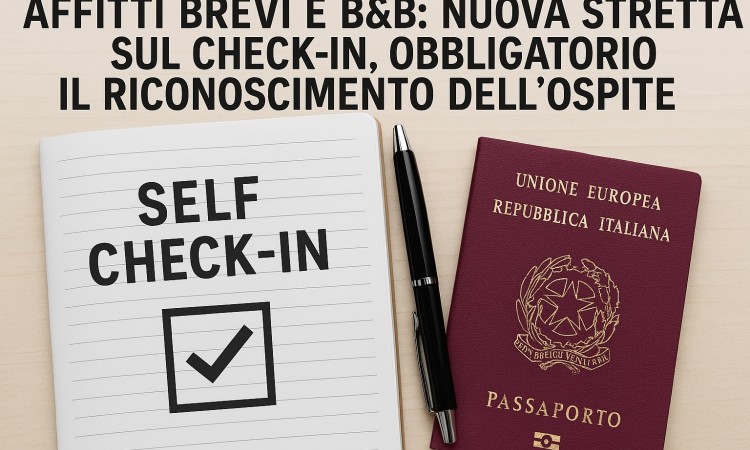
Short-term rentals and B&Bs: new restrictions on check-in, in-person guest identification
The short-term rental sector is entering a new regulatory phase. With a decision that will have an immediate impact on property owners, managers and professional operators, the Council of State has reinstated the obligation of in-person (“de visu”) identification of guests.
A ruling that overturns the position previously expressed by the Regional Administrative Court (TAR) of Lazio and brings the focus back to a crucial issue: safety, responsibility and proper guest verification.
What changes: end of fully automated self check-in
In recent years, the short-term rental market has seen the rapid spread of automated check-in systems: key boxes, access codes sent remotely, smart locks and identity verification through photos or apps.
Convenient solutions, especially for hosts who live far from the property or manage multiple units.
The new ruling, however, clarifies one point: Italian law requires the host to verify the guest’s identity in person.
According to the Council of State, this is not an optional measure but a necessary requirement for the proper application of Article 109 of the Public Security Act (TULPS).
This verification cannot be delegated to digital uploads, photo identification or unattended key systems.
Are video-based identification systems allowed?
The ruling does not completely dismiss technological solutions.
It states that identification may also occur via real-time video communication, provided that:
-
the host can clearly verify the guest’s face,
-
the document can be checked against the person,
-
the interaction takes place at the moment of arrival.
This leaves room for structured operators to adapt, while those relying entirely on automated systems will need to reorganize their processes.
Mandatory communication to authorities: unchanged rules, higher responsibility
The obligation to report guest information via the “Alloggiati Web” police portal remains unchanged:
-
within 24 hours of arrival,
-
within 6 hours if the stay is shorter than 24 hours.
What does change is the host’s responsibility: the ruling strengthens the requirement that identification must be properly carried out and verified.
Impact on property owners and hosts
Those managing properties remotely or relying on automation will experience the most immediate effects. Key implications include:
-
the need to be present at check-in or appoint a trusted representative,
-
possible additional costs for on-site personnel,
-
the need to adjust access systems and procedures,
-
the impossibility of using key boxes or smart locks without compliant video verification.
In tourist destinations like Versilia, where demand is strong yet diverse, this shift will require more structured and professional management practices.
Why investors should pay attention
Anyone buying a property for short-term rental income should consider that:
-
operating costs are likely to increase,
-
profitability will depend more on organizational efficiency,
-
regulatory standards will continue to tighten,
-
professional and reliable management will become a decisive competitive factor.
For small or occasional hosts this may represent a challenge, while more structured operators or professional agencies may find new opportunities.
Looking ahead
The short-term rental segment is clearly transitioning away from its early, informal phase toward more regulated hospitality standards.
The aim is not to hinder the market, but to ensure safety, traceability and compliance.
For operators who work with care and method, the impact will be manageable. For those improvising, the new framework will require significant adjustments.
A new regulatory milestone
The ruling of the Council of State establishes a clear principle: guest identification is not a mere formality, but a public-safety requirement.
Short-term rentals will remain an attractive opportunity, but within a tighter regulatory environment designed to protect both residents and travellers.
