

Real Estate Scams: Why Verifying Your Agent Is the Only Real Protection
Why It Is Essential to Always Verify a Real Estate Agent’s Professional Registration
In recent months, a story has circulated widely on social media about two owners of a villa in Calabria who were allegedly targeted by a sophisticated scam involving fake intermediaries, counterfeit money and a supposed “high-level real estate agency.”
The narrative has cinematic overtones, yet it remains unconfirmed by any official news source or police report, despite its viral spread.
Regardless of its accuracy, the story highlights a very real point: how vulnerable sellers and buyers can be when they rely on unqualified individuals — or worse, people intentionally attempting to deceive them.
The story circulating online: a fake broker and a briefcase full of paper
According to the version shared on social networks, two brothers had published an advertisement to sell their villa. A few days later, they were contacted by a supposed real estate agency claiming to represent an “important” buyer — allegedly connected to the Vatican.
Negotiations were reportedly handled by a man posing as a cleric, who promised the sellers both the official sale price and an additional undeclared cash payment.
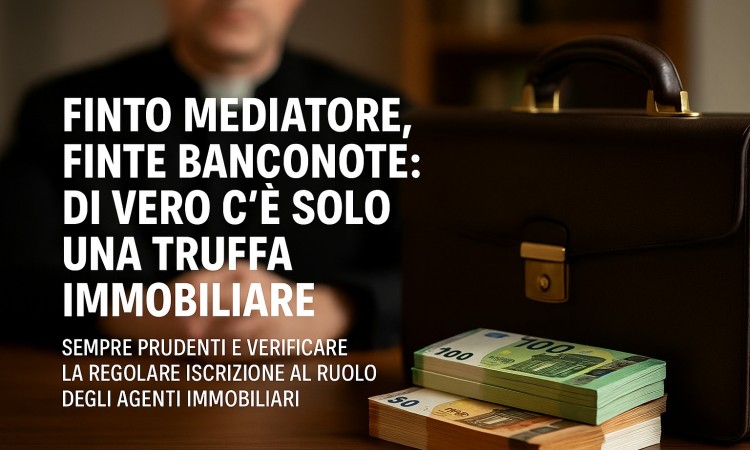
The scam allegedly unfolded when the owners, believing the operation to be legitimate, handed over €80,000 in gold bars in exchange for a briefcase that, once opened, contained nothing but facsimiles of banknotes.
Two elements, however, are clear:
-
this story is not supported by verified journalistic sources, and
-
real estate fraud is, unfortunately, far more common than many imagine.
Why situations like this can occur
The real estate sector — especially when private individuals handle transactions without professional support — becomes fertile ground for anyone who exploits:
-
the hope of earning extra profit
-
sellers’ inexperience
-
the complexity of legal and fiscal rules
-
trust placed in individuals who present themselves as “experts”
Promises of hidden payments, cash exchanges, inflated valuations or bureaucratic shortcuts are often the very first signs that something is wrong.
The key lesson: always verify who you are dealing with
In Italy, real estate mediation can only be carried out by licensed professionals, officially registered with the Chamber of Commerce.
It is a legal requirement — not a formality.
Relying on an unregistered intermediary means exposing yourself to:
-
no legal protection
-
no professional accountability
-
no insurance coverage
-
a significantly higher risk of fraud or misconduct
To protect yourself, it is always advisable to:
1. Verify the agent’s official registration
Request full name, Chamber of Commerce registration number and agency identification.
These records are public and easy to consult.
2. Avoid anyone who proposes undeclared cash payments
Besides being illegal, these mechanisms are the ideal environment for scams.
3. Always require written agreements and documentation
A legitimate agent operates transparently and does not avoid paperwork.
4. Make every payment through traceable channels
Bank transfers, cashier’s checks or notarial escrow deposits — never briefcases or informal handovers.
5. Consult a notary or lawyer before signing any document
A preliminary review helps prevent costly mistakes.
Why working with a qualified professional truly protects you
In an increasingly complex real estate market, the assistance of a licensed agent is not just convenient — it is a form of protection.
A properly registered professional:
-
verifies all property documentation
-
manages negotiations correctly
-
protects both sellers and buyers
-
prevents risky shortcuts
-
avoids situations like the one described online
When it comes to real estate, improvisation is never a wise choice.
A call for caution
The story of the “briefcase full of facsimile banknotes” may be nothing more than a viral tale, but real estate scams are, unfortunately, a genuine and recurring risk.
To avoid them, the priority is always the same: verify the identity and the professional licensing of the mediator.
Choosing a licensed real estate agent is not just a matter of correctness — it is a safeguard for your assets and for the success of the entire transaction.
INFO BOX
How to Verify Whether a Real Estate Agent Is Truly Licensed
In Italy, real estate mediation is regulated by Law 39/1989 and may only be carried out by individuals who meet specific legal requirements. To protect yourself from scams and unqualified intermediaries, it is essential to follow these checks:
1. Verify REA Registration with the Chamber of Commerce
Every licensed agent must appear in the Economic and Administrative Index (REA) of the local Chamber of Commerce.
Ask for:
-
the agent’s full name
-
REA number or VAT number
-
the agency’s official name
Verification can be done online in a few minutes.
2. Confirm the Qualification Certificate and Exam
A real estate agent can legally operate only if they have:
-
completed the required training course
-
passed the qualifying exam
-
obtained official registration as a mediator
Anyone lacking this process cannot legally perform brokerage.
3. Ensure a Written Brokerage Agreement Is Provided
Serious professionals work with:
-
a clear written mandate
-
transparent fee terms
-
signed and traceable documentation
Those who avoid formal agreements often lack the legal right to operate.
4. Check for Mandatory Professional Liability Insurance
Registered agents are required to carry professional liability insurance, protecting both the client and the mediator in case of errors or omissions.
If this coverage is missing, consider it a warning sign.
5. Beware of Cash Payments, Shortcuts or “Extra Earnings” Proposals
Untraceable payments, cash-filled briefcases or promises of additional undeclared gains are classic indicators of irregularity.
A licensed professional will never propose unlawful or opaque arrangements.
