

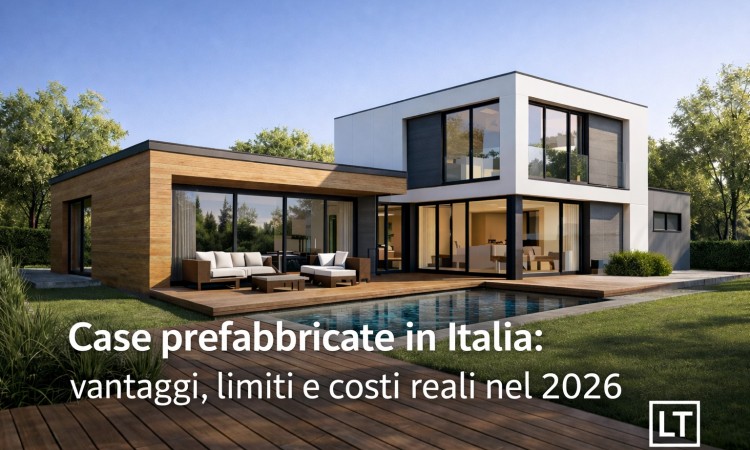
Prefabricated Homes in Italy in 2026
Prefabricated Homes in Italy in 2026
Not a shortcut, but a design-driven choice
There was a time when prefabricated homes were associated with temporary, marginal or experimental solutions. That time has passed.
In 2026, prefabrication has become part of the mainstream conversation about contemporary living, driven by predictable timelines, cost control and energy efficiency. Yet, as often happens, behind a popular term lies a more complex reality.
The real question is not whether prefabricated homes are “worth it”.
The real question is when and for whom they truly make sense.
What “prefabricated” really means today
Today, prefabricated does not mean standardised.
It refers to custom-designed homes, manufactured in factories and assembled on site on traditional foundations, fully compliant with Italian planning, structural and seismic regulations.
The most common solutions in 2026 include timber structures, followed by light steel systems and hybrid configurations. Visually, they are often indistinguishable from traditional homes. The real difference lies in the construction process, which is more controlled and industrialised.
Time: a real advantage, but not an instant one
Speed is often cited as the main benefit of prefabrication. That is true, but context matters.
While manufacturing and assembly are fast, design, permits and territorial constraints remain unchanged.
The result is not a house built in four months, but a more reliable construction timeline, less exposed to the uncertainties typical of traditional building sites. In construction, predictability is a major asset.
Costs: clarity above all
Prefabricated homes are not necessarily cheaper.
They are more transparent.
In 2026, the cost of the prefabricated structure alone typically ranges between €1,600 and €2,300 per square metre. Once foundations, design fees, permits, connections and external works are added, the final budget—excluding land—often approaches that of a high-quality traditional new build.
The difference lies less in the final figure and more in the control of the process leading to it.
Info box – What is often NOT included in “turnkey” prices
Many prefabricated home quotes appear competitive but often exclude:
• land purchase
• foundations and related works
• urbanisation charges and municipal fees
• architectural and structural design
• planning permits and approvals
• external works and utility connections
For this reason, real costs must always be assessed project by project, with a complete overview.
Energy efficiency: the true strength
Energy performance is where prefabrication truly excels.
High-performance envelopes, integrated systems and the ease of achieving top energy ratings make prefabricated homes well aligned with European policies and future market expectations.
In the medium term, energy efficiency is not just about comfort or sustainability.
It is about property value.
Customisation and design: guided freedom
A prefabricated home is a designed home, not an improvised one.
Customisation is extensive but must be defined early, within modular systems. Those who prefer making changes during construction may find this approach limiting.
Prefabrication rewards clear vision and penalises indecision.
Resale value: a cultural (and territorial) matter
Italy’s market, long attached to traditional masonry, is gradually evolving. A well-designed prefabricated home, properly integrated into its context and located in a strong area, does not face significant resale barriers. Poorly contextualised or overly standardised solutions, however, may still struggle.
As always, it is not the construction system that makes the difference, but where and how.
When prefabrication truly makes sense
It makes sense when:
• suitable building land is already available;
• reliable timelines matter more than unrealistic promises;
• energy performance is a true priority;
• the project is approached methodically, not through slogans.
In these cases, prefabrication is not a compromise, but a conscious design choice.
The LT Immobili & Design perspective
In our daily work, we see growing interest in prefabricated homes, often accompanied by oversimplified expectations.
The truth is that prefabrication is not an “easy” solution, but a rational one, effective only when supported by sound design, the right location and solid professional guidance from the outset.
Because even when a home is built in a factory, its value is created on the ground.
