

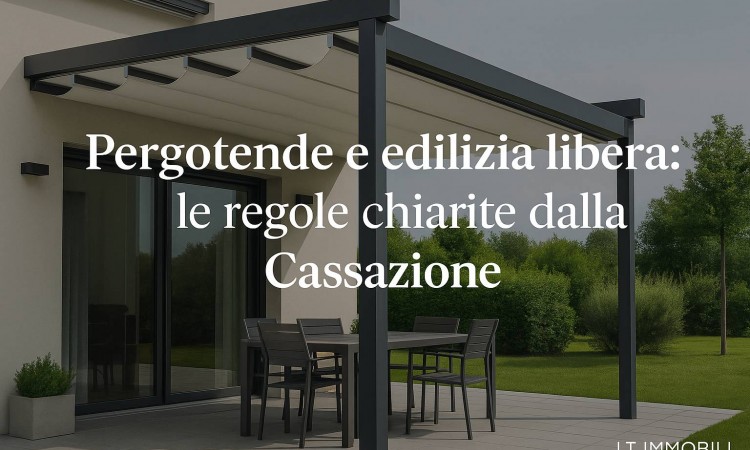
Pergolas with Retractable Covers (“Pergotende”) and Free-Building Regulations: What the Su
The 2025 ruling: a crucial clarification
With judgment no. 29638 of 22 August 2025, the Italian Supreme Court established an important principle: when a structure creates new volumes or enclosed spaces, it cannot be considered “free building” but instead requires a proper building permit.
The case specifically involved pergotende (pergolas with retractable covers), increasingly popular additions to terraces, gardens, and even restaurant outdoor areas—often built without full awareness of their legal implications.
This decision goes beyond a single case. It sets a precedent that municipalities and courts will be expected to follow in future evaluations.
What exactly is a “pergotenda”?
Administrative case law defines a pergotenda as a lightweight structure designed to protect against sun and weather.
-
It is not considered temporary or precarious, but rather a stable and durable element.
-
However, it must not become an enclosed environment or an extra habitable room.
-
Its main purpose is to improve the usability of balconies, terraces, and gardens by providing shade and shelter, without increasing the overall volume of the property.
In recent years, technological advances have introduced bioclimatic pergolas, with adjustable slats and waterproof retractable roofs. These modern and elegant solutions are highly desirable but require careful evaluation of compliance with planning regulations.
The updated regulatory framework: the “Decreto Salva Casa”
Decree-Law 69/2024, converted into Law 105/2024, updated the Italian Consolidated Building Code (Presidential Decree 380/2001), introducing new provisions regarding canopies, awnings, and retractable covers.
According to the current law, a pergotenda can fall under free building works (and therefore not require a building permit) if it meets all the following conditions:
-
it serves solely as protection against sun and weather;
-
it is made up of retractable or movable elements (including waterproof or bioclimatic systems);
-
it is attached to or annexed to an existing building;
-
it does not create enclosed spaces or new volumes;
-
it has a minimal visual impact, harmonized with the building.
If even one of these conditions is not met, the project is no longer free building: a proper permit is required.
When a building permit is required
The Supreme Court confirmed that a pergotenda becomes a building structure when it has features of stability or creates permanent enclosures. A permit is required in particular when:
-
the structure uses heavy, fixed pillars or masonry/steel frames;
-
the roof covering is not retractable but permanently fixed;
-
side walls or enclosures are added, creating a new habitable room.
In these cases, the pergotenda is no longer a light canopy but an extension of the home. The result: it must be authorized by the municipality through the appropriate building procedure.
Risks and penalties in cases of building abuse
Constructing a pergotenda without meeting the requirements for free building works exposes the owner to both administrative and criminal consequences.
Potential risks include:
-
an order to demolish and restore the original state;
-
significant financial penalties;
-
in cases of non-compliance, criminal charges for building violations.
This is why it is essential to seek professional guidance before starting any installation.
The real estate market perspective
Pergotende are highly valued as they enhance the livability of outdoor spaces and add elegance and functionality to a property. A well-designed pergola can increase the market value of a home, especially in lifestyle-driven locations like the Tuscan coast.
However, a non-compliant structure can create problems during a sale: during due diligence, a buyer may question its legal status, potentially slowing down negotiations or even blocking the deal.
Best practices for owners and buyers
If you are planning to install a pergotenda, always consult a qualified technician who can:
-
verify local planning regulations and municipal building codes;
-
determine whether the project falls under free building or requires a permit;
-
manage all communications with the municipality to avoid future disputes.
If you are buying a home with a pergotenda already in place, ask the seller to provide the building documentation. This ensures the structure is compliant and legally authorized.
Final note for LT Immobili readers
A pergotenda is an excellent investment to improve both the comfort and value of a home—but only if it complies with current regulations. Being aware of the legal framework today means avoiding penalties tomorrow and protecting your property’s long-term value.
