

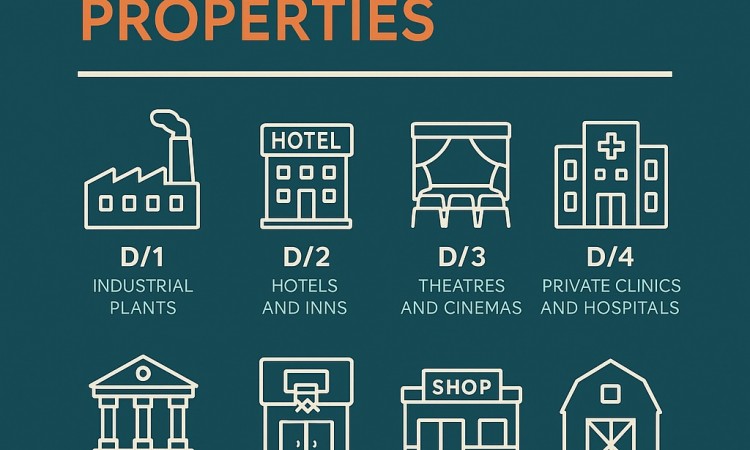
Land Registry Category Group D
Land Registry Category Group D: Special-Purpose and Productive Properties
Group D includes properties used for industrial, commercial, productive, or special-purpose services. These buildings, due to their construction and function, do not fall into the previously defined categories. Many are assessed using a direct valuation method, meaning they don’t rely on standard rate tables to determine cadastral income.
Let’s look at the individual subcategories and their main features.
Subcategories of Group D
D/1 – Industrial Plants (Opifici)
Industrial buildings where goods are manufactured or processed. These include large warehouses, production facilities, silos, and yards. They usually feature complex technological systems, high ceilings, and industrial gates. They are often located in outlying production areas.
D/2 – Hotels and Inns (for profit)
Hospitality structures offering rooms, reception areas, common spaces, and restaurants. Classified by star ratings. Must comply with fire safety, accessibility, and hygiene regulations. Cadastral income is linked to their hosting capacity.
D/3 – Theatres, Cinemas, Concert Halls (for profit)
Large venues with seating areas, stages, and control rooms. Specifically built for live entertainment and public gatherings. If they generate income, they are included in this category regardless of public or private ownership.
D/4 – Private Clinics and Hospitals (for profit)
Private healthcare facilities such as clinics, diagnostic centers, and nursing homes. Includes patient rooms, outpatient services, and medical equipment. Different from public hospitals (classified as B/2).
D/5 – Banks, Currency Exchange, and Insurance Companie
Financial institutions including banks and insurance agencies. Equipped with counters, consulting areas, and high-security systems. Specifically arranged for financial and administrative activities.
D/6 – Private Sports Facilities (for profit)
Gyms, pools, and sports fields operated by private individuals or companies. These must generate revenue and are distinct from non-profit sports buildings (C/4). Often include changing rooms, showers, lighting, and heating systems.
D/7 – Buildings for Industrial Use
Similar to D/1 but with more specific uses, such as refineries, power plants, or chemical factories. These are highly technical structures often subject to strict environmental and safety regulations.
D/8 – Commercial Buildings
Shopping malls, large stores, car dealerships, and supermarkets. Characterized by large indoor spaces, parking areas, display windows, and HVAC systems. They often have high cadastral income and are subject to property tax (IMU), even when vacant.
D/9 – Floating or Suspended Buildings
Structures not fixed to the ground, such as restaurants on barges or buildings on platforms. Included in this category if they are registered and used continuously.
D/10 – Agricultural Use Buildings (instrumental only)
Stables, tool sheds, silos, dryers, greenhouses. Must be used by professional farmers or agricultural entrepreneurs. These may be exempt from IMU if declared “instrumental to the agricultural activity.”
Fiscal Aspects
-
Many Group D properties are subject to direct valuation by the Revenue Agency;
-
Most are subject to IMU (municipal property tax) even if vacant;
-
Cadastral incomes are generally high, directly impacting local taxes;
-
D/10 buildings may benefit from tax relief if tied to agricultural activity.
Practical Examples
-
A shopping mall would be classified as D/8;
-
A private gym for paid use falls under D/6;
-
A private clinic is registered as D/4;
-
A building used by a company to produce jam would fall under D/1 or D/7 depending on the facility setup.
Group D is crucial for anyone involved in commercial or industrial real estate. Proper classification ensures accurate taxation, facilitates sales or purchases, and supports investment decisions.
Do you own or manage a special-use or productive building? Contact us for tailored guidance and classification support.
