

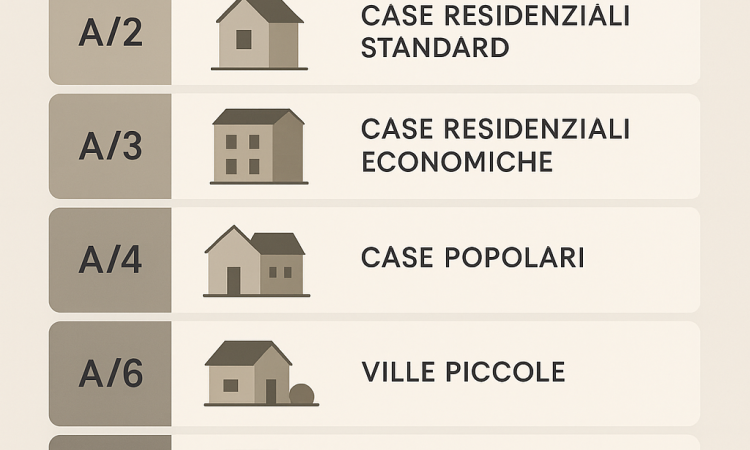
Land Registry Categories – Group A
Land Registry Categories – Group A: Homes and Offices Explained Simply
Group A mainly includes residential properties. It covers the houses we live in, villas, but also offices and certain types of buildings typical of some areas in Italy. Knowing these categories helps you understand how much tax you’ll pay on a property or whether you can access tax benefits.
Group A Categories – One by One
A/1 – Luxury Homes
Prestigious homes located in central or high-end residential areas. High-quality finishes: marble or fine parquet flooring, solid wood windows, smart home systems, high ceilings with decorations. Often feature a concierge, elegant elevator, and internal courtyard. High cadastral income and proportionally higher taxes.
A/2 – Standard Residential Homes
Apartments in buildings with standard construction, often built between the 1960s and 2000s. Medium-quality finishes: ceramic tiles, aluminum windows, central or independent heating, elevator, and compliant systems. The most common type in cities.
A/3 – Low-Cost Residential Homes
Buildings constructed with basic materials, often in suburban or working-class neighborhoods. Simple ceramic or grit floors, basic fixtures, sometimes outdated systems. Generally no elevator, and smaller in size. Lower cadastral income.
A/4 – Public Housing
Small units part of public housing projects. Low-cost materials, essential features, minimal and often shared spaces (e.g., courtyards). Intended for low-income families.
A/5 – Very Basic Public Housing (no longer in use)
This category is no longer used. It included homes with very modest construction: poor materials, no or unreliable systems, weak structures. These homes are now either reclassified or demolished.
A/6 – Rural Homes
Homes connected to farming activities. Simple finishes, often built in stone or brick, with tile roofs. May lack modern systems. Often part of a farmhouse or rural estate. May be eligible for benefits if used by farmers.
A/7 – Small Villas
Detached or semi-detached houses with a garden, vegetable patch, or private courtyard. Max two floors. Medium-good finishes: ceramic floors, wooden or aluminum windows, garage or parking space. Common in suburban or residential areas.
A/8 – Large Villas
Luxury detached homes with large gardens, swimming pools, panoramic terraces. Very high-end finishes: fine parquet, smart home systems, air conditioning, designer details, often architect-designed. High value and very high cadastral income.
A/9 – Castles and Historic Mansions
Properties of historical or artistic interest. May include frescoes, coffered ceilings, monumental halls, Italian-style gardens, towers or ramparts. Maintenance is complex and regulated by heritage protection authorities. Exempt from certain taxes if officially recognized as historically important.
A/10 – Offices and Studios
These are not residential but professional spaces. Equipped with specific systems (e.g., data networks, office lighting), often in mixed-use buildings with separate entrances. Finishes vary from basic medical offices to high-end notary studios. Not eligible for first-home tax benefits.
A/11 – Traditional Homes
Buildings tied to local traditions: trulli, alpine cabins, Sardinian stazzi. Natural materials (stone, wood), sloping roofs, fireplaces. Often renovated for tourism. May qualify for renovation grants.
Fiscal and Planning Implications
-
The cadastral income is used to calculate property taxes (IMU, TASI, IRPEF);
-
Non-luxury homes (like A/2, A/3, A/4, A/5, A/6, A/7) may qualify for first-home tax benefits;
-
Offices (A/10) do not qualify for tax discounts available to homes;
-
Some special properties (like A/6 or A/9) may be eligible for tax reductions if they meet certain criteria.
Two Examples to Understand It Better
-
If an A/2 apartment has a cadastral income of €1,000, you multiply it by 160 to calculate the IMU: the taxable value will be €160,000.
-
If a doctor has their office in an A/10 property, they cannot apply for first-home tax benefits.
Why It’s Useful to Know Your Property’s Category
Knowing your property’s category helps you:
-
Pay taxes correctly;
-
Understand if you’re eligible for discounts or bonuses;
-
Plan a change of use or renovation more efficiently.
Need help figuring out your property’s category? Ask us for a free consultation!
