

From the 2025 market to CasaGreen
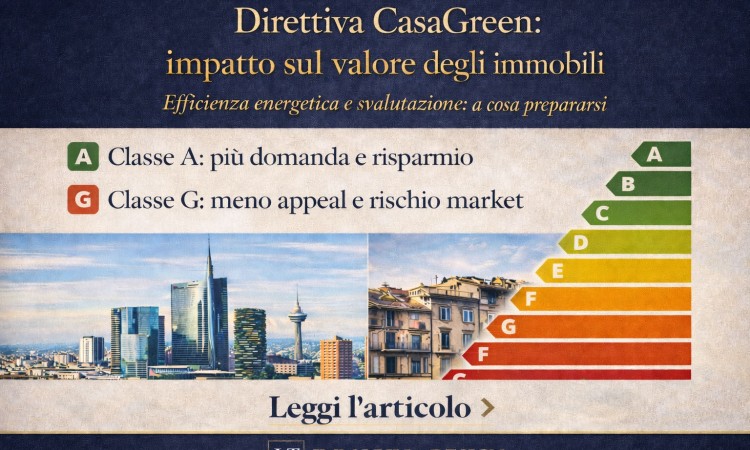
Why energy class A homes will become increasingly sought after, while class G properties risk significant devaluation
From the 2025 market to CasaGreen: the common thread
In our previous article on the Italian real estate market in 2025, we highlighted how price growth is no longer uniform, but increasingly selective.
Location, quality and property type already make a tangible difference today.
The CasaGreen Directive represents the next step in this evolution:
if the market is currently rewarding quality, in the coming years it will reward energy efficiency above all.
This article focuses precisely on this issue:
how property attractiveness will change and what risks (or opportunities) lie ahead for property owners.
That snapshot of the market, however, represents only part of the picture.
There is a structural factor that will have an even deeper impact on value, liquidity and marketability in the coming years: the entry into force of the CasaGreen Directive.
If the market already rewards quality today, tomorrow it will primarily reward energy efficiency.
CasaGreen: what really changes
The European Directive on the energy performance of buildings, known as CasaGreen, was introduced with a clear objective: to significantly reduce the environmental impact of the building stock.
For the real estate market, this translates into a concrete consequence:
energy efficiency becomes a central economic factor, no longer a secondary or marginal element.
In the coming years:
-
energy-efficient homes will be increasingly sought after;
-
energy-intensive properties will face growing penalties, even in markets currently considered strong.
Energy class A properties (or similar): why they will become increasingly attractive
Homes in energy class A, A4 or equivalent already enjoy a clear competitive advantage.
Not only because they consume less energy, but because they better meet the new demands of the market.
More qualified demand
Families, international buyers and investors are paying increasing attention to overall running costs. An efficient home offers greater predictability, comfort and long-term peace of mind.
Better access to credit
Banks are progressively rewarding properties with high energy performance, viewing them as more solid and less exposed to depreciation risk. This results in easier access to mortgages and, in some cases, more favorable lending conditions.
Stronger value retention over time
In the new scenario, a class A home is not just “more modern”:
it is more liquid, easier to sell, and better able to retain its value even during less dynamic market phases.
Energy class G properties (or similar): the concrete risk of devaluation
While the market increasingly rewards efficiency, it also penalizes properties in energy class G, F or E, which still represent a significant portion of the Italian housing stock.
Here, the risk is not theoretical, but very real.
Fewer interested buyers
An increasing number of buyers automatically exclude low-efficiency properties, especially when they require major and hard-to-quantify renovation works.
Greater pressure on prices
Without energy upgrades, these properties risk:
-
more aggressive negotiations;
-
increasing price reductions;
-
longer selling times.
In the medium term, value loss may become structural, particularly in markets with abundant supply.
The greatest risk: illiquidity
The real danger is not just selling at a lower price, but not being able to sell at all.
An energy-inefficient, poorly positioned and outdated property can become unattractive to the market, remaining unsold for a long time.
Why timing is crucial
As already highlighted in the 2025 market analysis, the real estate sector often anticipates regulatory changes.
CasaGreen is not a distant future event: its effects are already influencing buyers’ decisions today.
Acting early allows owners to:
-
plan interventions more clearly and strategically;
-
enhance the property before putting it on the market;
-
avoid value erosion imposed by changing market conditions.
The role of real estate consultancy today
In this new scenario, knowing average local prices is no longer enough. A deeper analysis is required, integrating:
-
market dynamics;
-
regulatory frameworks;
-
the technical characteristics of the property.
LT Immobili & Design supports property owners throughout this process, helping them understand when to act, how to enhance their property, and how to position it correctly on the market.
Because, as we have seen when discussing the 2025 market, value no longer depends only on where a home is located, but increasingly on how it is built and prepared for the future.
Do you own a property for sale or are you considering putting it on the market?
In the new regulatory and market environment, understanding when to intervene and how to position a property correctly has become essential.
With LT Immobili & Design, we support property owners in reading the market, evaluating not only price, but also energy performance and the real potential for value enhancement.
Because today, value depends not only on where a home is located,
but increasingly on how well it is prepared for the future.
