

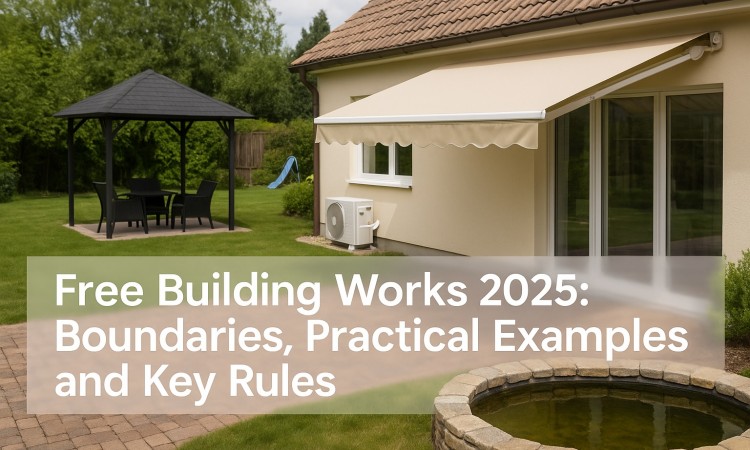
Free Building Works 2025: The Delicate Boundaries of Pergolas, “Pergotende” and VEPA
Why these works create uncertainty
While ordinary maintenance (painting, replacing floors, etc.) is clear and rarely disputed, the situation becomes more complex with light outdoor structures. Pergolas, pergotende and removable panoramic glass enclosures (VEPA) are increasingly popular in homes, especially for gardens, terraces, and loggias.
The issue is that although they improve comfort and usability, they may also risk being classified as new, enclosed volumes, which would require a building permit.
For this reason, regulations have been updated several times, clarifying what is admissible as free building work and what requires authorization.
VEPA – Removable Panoramic Glass Enclosures
-
Consist of transparent, sliding glass panels that protect loggias and balconies without turning them into enclosed rooms.
-
They are admitted under free building works if they meet these requirements:
-
total transparency,
-
removability and reversibility,
-
no creation of a new enclosed, habitable space,
-
guarantee of natural micro-ventilation,
-
minimal visual impact on the building.
-
-
Important: in protected areas or historic centers (“Zone A”), specific authorization may still be required.
Pergolas and retractable awnings
-
These are light structures designed to provide shade and protection from weather conditions.
-
Considered free building works if:
-
equipped with retractable fabric or movable elements,
-
not permanently enclosed at the sides,
-
do not create new spaces usable as actual living rooms.
-
-
If the pergola is closed with rigid elements (glass or masonry), it becomes a veranda and requires a building title (SCIA or Building Permit).
Supreme Court ruling no. 29638/2025
A recent judgment clarified that a pergotenda qualifies as free building work only if it remains a retractable awning with light support structures.
Once it is completed with permanent closures or rigid elements, it is no longer a temporary cover but a new building volume, requiring authorization.
In other words, the key distinction is reversibility and volumetric impact.
Why this matters
Many homeowners believe that “it’s just a canopy” and therefore always allowed. In reality, if the structure becomes an enclosed and usable room, they risk penalties, demolition orders, and disputes.
Understanding the boundaries of free building works means:
-
avoiding unnecessary expenses in case of disputes,
-
maintaining full planning compliance of the property,
-
ensuring a smoother and safer future property sale.
In the next article we will cover:
-
practical examples of what can be done indoors and outdoors,
-
the works that do not fall under free building works,
-
the 7 golden rules every homeowner should know.
