

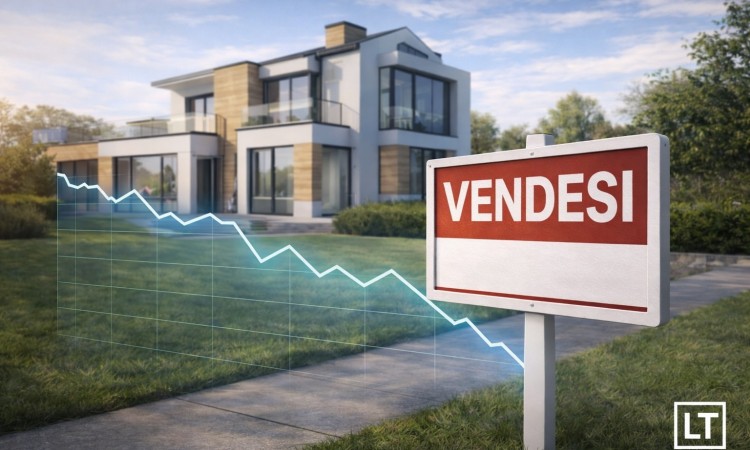
Asking Price vs Market Price: Why Many Properties Remain Unsold for Months
One of the most frequent questions asked by property owners is:“Why isn’t my home selling?”
It’s a question many homeowners begin to ask after weeks — sometimes months — of waiting.
In most cases, however, the answer is not the property itself.
It’s not (only) about size, layout, orientation, or finishes.
More often than not, the real issue is the price.
There is frequently a subtle but decisive gap between the asking price and the property’s true market value. A gap that is not always easy to recognize, especially when personal expectations, emotional attachment, past investments, or misleading comparisons with “similar” properties come into play.
Today’s real estate market is increasingly selective and quick to send clear signals:
a correctly priced property generates interest, enquiries, and viewings within the first days;
an overpriced one is observed, compared… and then quietly set aside.
It is in this silent phase that the sale begins to slow down or come to a halt — not because the home lacks value, but because that value is not aligned with current market dynamics.
Understanding where your property truly stands in today’s market is the first — and most crucial — step toward a successful sale. And it is often the hardest one to take without an objective, professional assessment.
The emotional price is influenced by:
-
personal memories
-
past investments
-
outdated or irrelevant comparisons
Market price, on the other hand, is determined by:
-
real demand
-
comparable properties that have actually sold
-
average time on the market
Confusing these two concepts is one of the most common mistakes.
In the 2025–2026 market:
-
buyers are better informed
-
they compare many alternatives
-
they carefully assess future costs (energy efficiency, renovations)
An overpriced property is rarely negotiated. It is simply ignored.
Many owners choose to “test the market” with a high asking price.
The consequences are often:
-
prolonged time on the market
-
a negative perception of the property
-
lower offers than those that might have been achieved initially
The market penalises unrealistic pricing strategies.
An effective valuation takes into account:
-
the actual quality of the location
-
the condition of the property
-
energy performance
-
the status of documentation
- comparison with recently sold properties, not active listings
This is a technical process, not an intuitive estimate.
Correct pricing does not mean underselling
A well-positioned price:
-
generates interest
-
increases viewings
-
creates competition
-
protects perceived value
In many cases, it leads to better results, not lower ones.
Our approach always starts with a realistic market analysis, not with promises.
A correctly positioned property:
-
conveys credibility and professionalism
-
attracts informed and motivated buyers
-
reduces long, exhausting negotiations
