

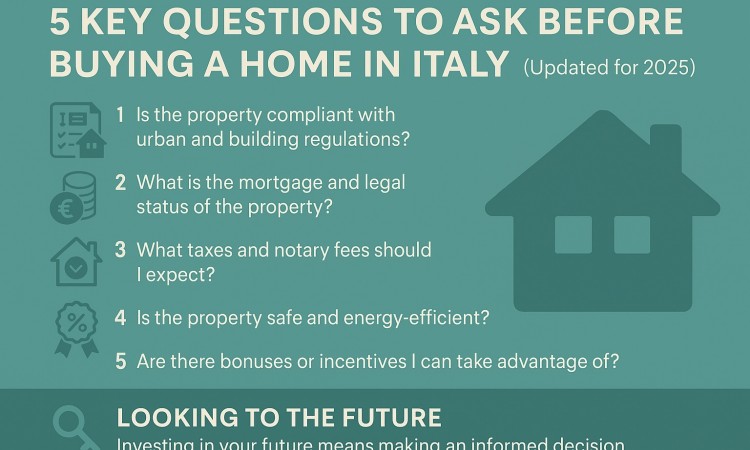
The 5 Key Questions to Ask Before Buying a Home in Italy (Updated for 2025)
Buying a home is one of life’s most important decisions: a step that combines emotion, investment, and long-term security.
But before signing the contract, it’s essential to ask yourself a few decisive questions that help avoid risks and make the purchase truly safe.
Here are the 5 key questions to ask before buying a home in Italy, updated to the 2025 regulations.
1. Is the property compliant with urban and building regulations?
Always request documentation proving urban and cadastral compliance:
-
Comparison between the cadastral floor plan and the property’s actual condition.
-
Verification of any building irregularities.
-
Confirmation that all permits (building permits, amnesties, regularizations) are in order.
A home with irregularities can block the sale or generate unexpected costs for compliance.
2. What is the mortgage and legal status of the property?
It is essential to ensure the property is free from mortgages, foreclosures, or restrictions.
-
The notary carries out an updated mortgage search.
-
Ask whether there are rights of way, easements, or specific restrictions.
Only a thorough check can fully protect the buyer.
3. What taxes and notary fees should I expect?
Beyond the purchase price, consider:
-
Registration tax, VAT, or cadastral/transfer taxes (depending on whether it’s a first or second home, or a purchase from a developer).
-
Notary fees and related expenses.
-
Any extraordinary condominium costs already approved.
Knowing the total cost in advance prevents financial surprises.
4. Is the property safe and energy-efficient?
Today more than ever, safety and efficiency directly impact the property’s value.
-
Verification of the compliance of systems (electrical, plumbing, gas).
-
Updated Energy Performance Certificate (APE).
-
Energy upgrades already done or still available (2025 incentives).
An efficient home reduces expenses and increases its value over time.
5. Are there bonuses or incentives I can take advantage of?
In 2025, several measures are still available:
-
Renovation Bonus (50% deduction over 10 years).
-
Ecobonus up to 65% for energy-saving upgrades.
-
Superbonus 75% for specific types of refurbishment.
-
Incentives for first-home buyers under 36 (with income requirements).
Getting informed in advance can make the difference between a “simple” purchase and a smart investment.
Looking to the Future
Buying a home is not just about choosing walls and rooms—it’s about investing in your future.
Asking the 5 right questions helps avoid risks and ensures a confident, informed purchase.
A decision made carefully becomes not only a personal achievement but also an asset that grows in value over time.
